Comprehensive Exterior Restoration for Commercial, Multi-Unit, and Residential Properties
Every masonry building ages. Mortar joints erode, bricks spall, lintels rust, and sealant fails. When multiple systems deteriorate at once, isolated repairs are not enough. The building needs a coordinated restoration plan that addresses the full exterior envelope: brick, stone, concrete, lintels, sealants, waterproofing, and drainage, all working together to keep moisture out and structural integrity intact.
At North Shore Masonry, we deliver full-scope building restoration services for property owners, condo associations, HOA boards, landlords, and commercial property managers across Chicago, Milwaukee, Denton TX, and Fort Wayne IN. With over 47 years in the masonry trade and crews averaging 15+ years of tenure, we bring the diagnostic experience and trade knowledge to identify what is failing, why it is failing, and how to fix it in the right sequence so the work lasts.
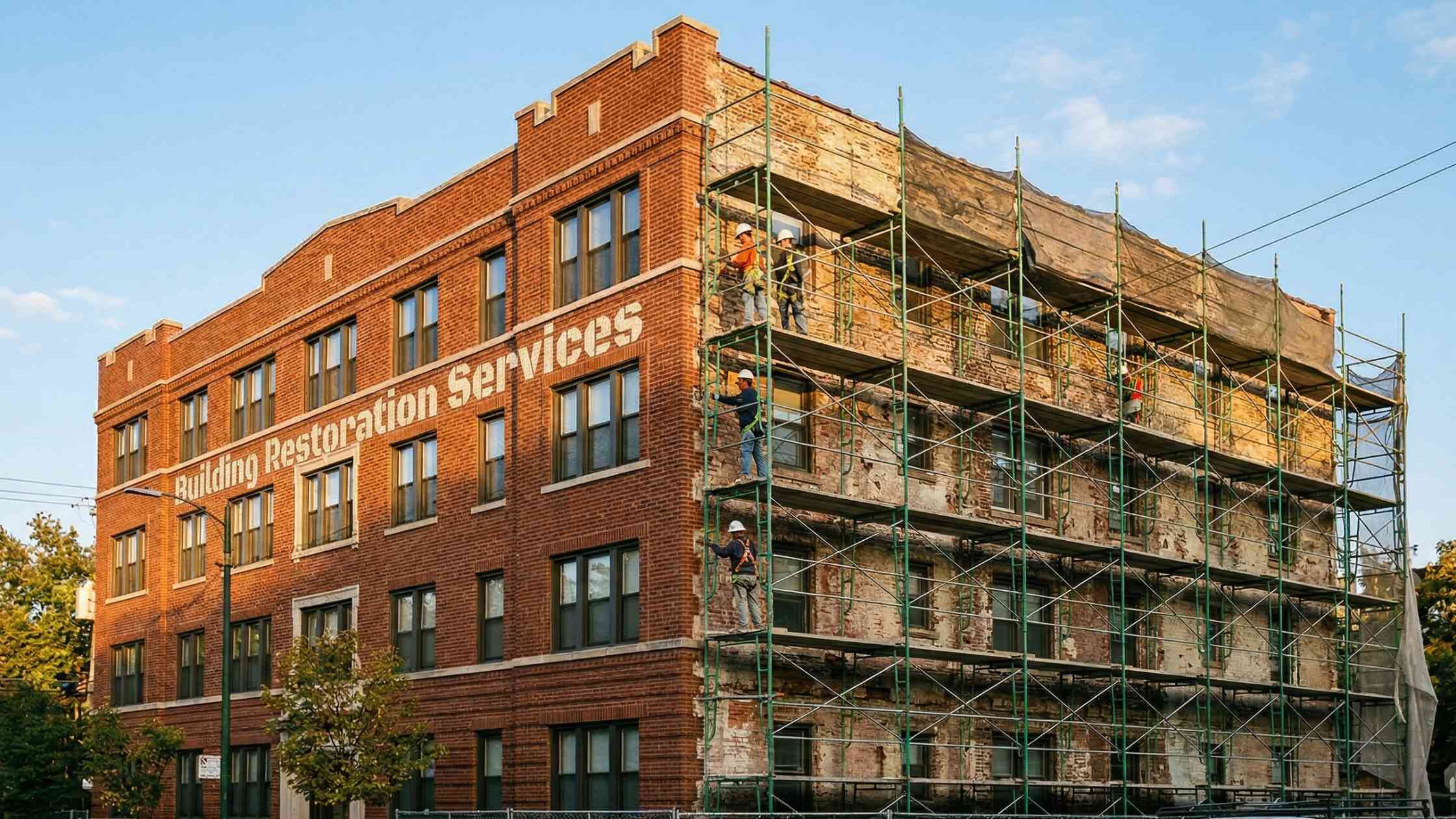
Building restoration is not one repair. It is a coordinated scope of work that may include tuckpointing, brick replacement, lintel repair, caulking and waterproofing, concrete patching, limestone restoration, and surface cleaning, all executed in the proper order by a single crew that understands how each system affects the next.
What Is Building Restoration?
Building restoration is the process of returning a structure’s exterior masonry envelope to sound, weather-tight condition. Unlike a single-trade repair such as tuckpointing one wall or replacing a few bricks, building restoration treats the facade as a complete system. It evaluates every component that affects moisture management, structural load transfer, and long-term durability.
A proper building restoration scope typically addresses:
- Mortar joints across all elevations, not just the worst wall
- Damaged or displaced bricks from spalling, cracking, or settlement
- Corroded steel lintels above windows and doors
- Failed caulking and sealants at expansion joints, window perimeters, and copings
- Deteriorated limestone, concrete, or terra cotta elements
- Waterproofing and drainage issues that allow moisture into the wall cavity
- Surface cleaning to remove pollution, biological growth, and staining
The goal is not cosmetic improvement alone. It is to extend the building’s functional lifespan by decades while protecting occupants, reducing ongoing maintenance costs, and preserving architectural character.
Why Buildings Need Full Restoration Instead of Patchwork Repairs
Property owners frequently call us after spending years patching individual problems. A section of tuckpointing here, a lintel replacement there, new caulking around the windows every few years. The building keeps leaking. The repairs keep failing. The cost keeps climbing.
This happens because masonry systems are interconnected. Replacing a lintel without addressing the failed flashing above it means water still enters the wall cavity. Tuckpointing the front elevation while ignoring the parapet cap allows moisture to travel down from the top. Sealing expansion joints without repairing the deteriorated mortar behind them traps water instead of keeping it out.
Full building restoration solves this by treating the exterior as a single system. Every component is assessed, prioritized, and repaired in the correct sequence so each fix supports the next. The result is a weather-tight envelope that performs as designed, not a patchwork of isolated repairs that leave gaps for moisture to exploit.
Common Scenarios That Call for Full Restoration
- Condo associations and HOA boards facing deferred maintenance across all four elevations of a courtyard building or six-flat
- Commercial property managers managing aging portfolios of multi-unit buildings with recurring leak complaints from tenants
- Homeowners with older brick homes where decades of freeze-thaw damage in Chicago or Milwaukee have affected mortar, bricks, chimneys, and lintels simultaneously
- Buildings approaching or failing a facade inspection under Chicago’s Exterior Wall Ordinance or similar municipal requirements
- Properties being prepared for sale or refinancing where a thorough exterior restoration protects and increases asset value
- Historic structures requiring historically accurate materials and techniques to preserve architectural integrity
Our Building Restoration Process
Every building restoration project at North Shore Masonry follows a structured process. We do not start swinging hammers until we understand the full scope of what the building needs. This approach prevents the missed items and change orders that come from starting work before completing the assessment.
1. Facade Inspection and Condition Assessment
We begin with a thorough visual and hands-on inspection of the building’s exterior. Depending on the structure, this may involve ground-level observation, ladder access, or swing-stage rigging for taller buildings. We document mortar condition, brick integrity, lintel status, caulking failures, drainage paths, flashing condition, and any structural movement such as cracking patterns, bulging walls, or displaced elements.
For buildings in Chicago subject to the city’s Exterior Wall Ordinance (Chicago Building Code 13-196-033), our inspection covers the specific requirements for periodic critical examination of ornamental elements, parapet walls, and lintels at mandated intervals.
The inspection produces a detailed report with photographic documentation, a prioritized list of repairs, and a recommended scope of work.
2. Scope Development and Sequencing
Based on the inspection findings, we develop a comprehensive restoration scope. The sequence matters. For example:
- Lintel replacement must happen before tuckpointing the surrounding brickwork, because the brick needs to be removed and replaced to access the lintel
- Waterproofing is applied after all mortar and sealant work is complete, not before
- Surface cleaning is typically performed early to expose hidden damage, but final cleaning happens after all repairs are finished
- Caulking at expansion joints and window perimeters is one of the last steps, applied to clean and properly prepared surfaces
Getting this sequence wrong wastes money and compromises results. Our experience managing hundreds of multi-trade restoration projects means we plan the work so each step builds on the one before it.
3. Material Selection and Mortar Matching
Material compatibility is critical in restoration work. New mortar that is too hard for the existing brick will cause the brick to crack. Replacement brick that does not match the original in size, color, and absorption rate will stand out visually and may perform differently in freeze-thaw conditions.
We match mortar color, texture, and composition to the existing material. For older buildings, particularly Chicago greystones, pre-war two-flats, and historic Milwaukee duplexes, this often means working with lime-based mortars rather than modern portland cement mixes. The mortar must be softer than the brick to absorb movement and allow moisture to escape, which is the fundamental principle of durable masonry.
4. Restoration Execution
Our crews execute the full scope of work on-site, typically handling tuckpointing, brick replacement, lintel work, concrete patching, caulking, and waterproofing with a single team. This eliminates the coordination problems that arise when a property owner hires separate contractors for each trade. One crew, one project manager, one point of accountability.
During execution, we maintain clean and safe work areas, protect landscaping and adjacent surfaces, and communicate progress to the building owner or property manager on a regular schedule.
5. Final Inspection and Quality Assurance
After all restoration work is complete, we perform a final walkthrough inspection. We verify mortar joint quality, brick alignment, lintel integrity, sealant adhesion, and overall appearance. Any items that do not meet our standards are corrected before the project is closed.
All work is backed by our 2-year labor and material warranty.
Building Restoration Services We Provide
A building restoration project may include any combination of the following services, depending on what the inspection reveals:
Tuckpointing and Mortar Joint Repair
The most common component of any building restoration. We remove deteriorated mortar and replace it with new, color-matched material across all affected elevations. This includes spot tuckpointing for localized damage, 100% tuckpointing for walls with widespread failure, and full-grind tuckpointing for buildings requiring complete mortar replacement. Learn more about our tuckpointing services.
Brick Replacement and Structural Repair
Spalled, cracked, or displaced bricks are removed and replaced with matching units. For walls showing structural issues such as bulging, cracking patterns, or displacement from foundation movement, we diagnose the root cause and implement stabilization before replacing damaged masonry.
Lintel Repair and Replacement
Corroded steel lintels above windows and doors are one of the most common causes of cracking and water infiltration in brick buildings. We remove the damaged lintel, install a new galvanized or stainless steel lintel with proper flashing, and rebuild the brickwork above the opening. Learn more about our lintel services.
Chimney Repair and Rebuilding
Chimneys deteriorate faster than any other part of the building because they are exposed on all four sides and from the top. Building restoration frequently includes chimney tuckpointing, crown repair, cap replacement, flashing repair, and in severe cases, full chimney rebuilds with new flue liners. Learn more about our chimney services.
Limestone and Concrete Restoration
Limestone sills, lintels, copings, and decorative elements are restored through patching, dutchman repairs (partial stone replacement), or full replacement with quarry-matched stone. Concrete elements including steps, foundations, lintels, and balconies are repaired through patching, resurfacing, and structural reinforcement. Learn more about our limestone services.
Caulking, Sealing, and Waterproofing
Failed caulking at expansion joints, control joints, window and door perimeters, and copings is removed and replaced with appropriate sealant materials. After all masonry repairs are complete, breathable water repellents can be applied to protect the restored surfaces from future moisture absorption. Learn more about our sealing and waterproofing services.
Stucco and EIFS Repair
Buildings with stucco or EIFS (Exterior Insulation and Finish System) facades may require crack repair, delamination correction, moisture intrusion remediation, or partial re-application as part of the restoration scope. Learn more about our stucco services. | Learn more about our EIFS services.
Surface Cleaning
Pollution staining, efflorescence, biological growth, and old paint are removed using appropriate methods for the substrate. We use low-pressure washing, chemical cleaning, steam cleaning, or sandblasting depending on the material and sensitivity of the masonry surface.
Facade Inspections and Proactive Maintenance Programs
For property managers and building owners who want to stay ahead of deterioration, we offer periodic facade inspection services and proactive maintenance programs. Regular inspections catch small issues before they become expensive restoration projects. This is particularly valuable for condo associations managing aging buildings and commercial property managers with multi-building portfolios.
Types of Buildings We Restore
Our building restoration experience spans residential, commercial, multi-unit, and institutional properties. The specific challenges differ by building type, age, construction method, and regional climate conditions across our four service markets.
Chicago and North Shore Properties
Chicago’s building stock presents unique restoration challenges. Classic greystones in Lincoln Park and Lakeview use Indiana limestone facades over common brick, requiring careful lime-mortar matching. Two-flats and three-flats in Wicker Park, Logan Square, and Bucktown often have soft common brick that demands softer mortar to prevent brick spalling. Courtyard buildings and six-flats throughout the North Side and near suburbs like Evanston, Oak Park, and Skokie commonly need simultaneous lintel replacement, tuckpointing, and parapet repair after decades of freeze-thaw cycling. See our full Chicago service area.
Milwaukee Properties
Milwaukee’s historic cream city brick is softer than modern brick and extremely sensitive to hard portland cement mortars. Restoration of Milwaukee buildings, particularly in neighborhoods like Bay View, Walker’s Point, and the East Side, requires lime-based pointing mortars and careful cleaning methods to avoid damaging the original brick. Lake-effect moisture and heavy freeze-thaw cycles make waterproofing and proper flashing especially critical. See our full Milwaukee service area.
Denton and North Texas Properties
North Texas buildings face different threats than Midwest properties. Extreme heat, UV exposure, and expansive clay soils cause foundation movement that produces stair-step cracking patterns in brick walls. Restoration in Denton and surrounding communities focuses on addressing structural movement, repairing resulting masonry damage, and sealing against wind-driven rain during storm season. See our full Denton service area.
Fort Wayne Properties
Fort Wayne’s mix of historic downtown commercial buildings and residential neighborhoods presents restoration needs similar to Chicago: freeze-thaw mortar deterioration, lintel corrosion, and moisture infiltration through aging sealants. Our Fort Wayne service area covers the city and surrounding communities including New Haven, Huntington, and Auburn.
Multi-Unit and Commercial Buildings
Condo associations, HOA boards, and commercial property managers face the added complexity of coordinating restoration work around tenants and occupants. We schedule work to minimize disruption, communicate timelines clearly, and provide documentation that boards and managers need for reserve fund planning, insurance claims, and owner communications.
Signs Your Building Needs Restoration
Not every building needs a full restoration. But certain patterns of deterioration indicate that isolated repairs will not solve the underlying problems. Consider a building restoration assessment if you observe:
- Mortar deterioration on multiple elevations, not just one wall
- Horizontal cracking above windows, a classic sign of corroded lintels pushing outward
- Water infiltration appearing at multiple locations inside the building
- Efflorescence (white salt deposits) on large sections of the facade
- Spalling bricks where the face of the brick is flaking or popping off
- Failed caulking at multiple joints, windows, or copings
- Stair-step cracking patterns indicating structural movement or settlement
- Bulging or displaced brickwork where the wall face is separating from the backup structure
- Previous repairs that have already failed, suggesting the root cause was not addressed
- Recurring leak complaints from tenants despite past repair attempts
If three or more of these conditions are present, a comprehensive facade inspection is the right starting point. It may reveal that targeted repairs are still sufficient, or it may confirm that a full restoration scope is the most cost-effective path forward.
Facade Inspections and Chicago’s Exterior Wall Ordinance
In Chicago, buildings constructed substantially of brick are required to undergo periodic critical examinations of their exterior walls under the city’s Exterior Wall Ordinance. This includes inspection of ornamental elements and parapet walls at four-year intervals, lintel examinations at four-year intervals, and an ongoing inspection and repair program for the remainder of the exterior at two-year intervals.
North Shore Masonry works with building owners and condo associations to address the repair and remediation items identified in these inspection reports. When the inspector’s report calls for tuckpointing, lintel replacement, caulking, or other masonry repairs, we execute the recommended scope of work and document completion for the building’s compliance records.
If you have received a facade inspection report recommending repairs, contact us for an estimate to address the identified items.
Why North Shore Masonry for Building Restoration
- 47+ years in the masonry trade. Founded in 1978, we have restored buildings across four states and every type of construction from single-family brick homes to multi-story commercial facades.
- MCAA Member. Our membership of the Mason Contractors Association of America reflects our commitment to trade standards and professional development.
- Experienced, stable crews. Our crews average 15+ years with the company. You get experienced tradespeople on your project, not a revolving door of subcontractors.
- 2-year labor and material warranty. Every restoration project is backed by our written warranty covering both workmanship and materials.
- Single-source accountability. We handle tuckpointing, brick, lintels, caulking, waterproofing, limestone, and concrete with our own crews. One contractor, one scope, one point of responsibility.
- Four markets, local knowledge. We understand the specific building types, climate challenges, materials, and code requirements in Chicago, Milwaukee, Denton, and Fort Wayne.
Frequently Asked Questions
What is the difference between building restoration and tuckpointing?
Tuckpointing is the repair of mortar joints between bricks. Building restoration is a comprehensive scope that may include tuckpointing along with brick replacement, lintel repair, caulking, waterproofing, limestone restoration, concrete patching, and surface cleaning. Tuckpointing is one component of a building restoration. When multiple systems are failing simultaneously, a full restoration addresses everything in the correct sequence rather than fixing one element at a time.
How long does a building restoration project take?
Project timelines depend on the building size, number of elevations requiring work, the scope of repairs, and weather conditions. A single-family home with moderate restoration needs may take one to two weeks. A multi-unit building or commercial property with extensive deterioration across all elevations can take four to eight weeks. We provide a detailed timeline during the scoping phase before work begins.
How much does building restoration cost?
Cost depends on the scope of work, building size, access requirements (scaffolding, swing stages, lifts), and the types of repairs needed. A facade inspection and assessment is the first step to developing an accurate scope and estimate. Visit our pricing page for realistic cost ranges on individual services, or request a free estimate for your specific project.
Do you work with condo associations and HOA boards?
Yes. We regularly work with condo associations, HOA boards, and property management companies on multi-unit building restorations. We provide detailed scopes and estimates suitable for board review and reserve fund planning, and we coordinate work schedules to minimize disruption to residents.
Is building restoration necessary if only one wall looks damaged?
Not always. If damage is genuinely limited to one area and the cause is localized, targeted repairs may be sufficient. However, the wall you can see from the street is often not the only one with problems. North-facing walls hold moisture longer. Parapets and chimneys take more weather exposure. A full inspection of all elevations ensures you are not investing in one wall while worse problems develop on another.
Do you handle facade inspection compliance work in Chicago?
Yes. When a licensed inspector identifies masonry repairs needed under Chicago’s Exterior Wall Ordinance, we execute the recommended scope of work including tuckpointing, lintel replacement, parapet repair, and caulking. We document completed repairs for the building’s compliance records.
What areas do you serve?
We provide building restoration services in Chicago and the North Shore suburbs, Milwaukee and southeastern Wisconsin, Denton and North Texas, and Fort Wayne and northeastern Indiana.
Can you match the original mortar and brick on older buildings?
Yes. Mortar matching is one of the most important aspects of restoration work. We analyze the original mortar’s color, texture, and composition, then create a custom blend that replicates it. For brick replacement, we source matching units in size, color, and texture. On historic buildings, we use lime-based mortars and historically compatible materials to preserve the structure’s integrity and appearance.
Request a Building Restoration Estimate
If your building shows signs of widespread masonry deterioration, or if you have received a facade inspection report recommending repairs, contact North Shore Masonry for a thorough assessment and detailed estimate.
Or call us directly:
- Chicago: (847) 864-5990
- Milwaukee: (414) 404-9029
- Denton: (469) 409-3515
- Fort Wayne: (260) 305-8760