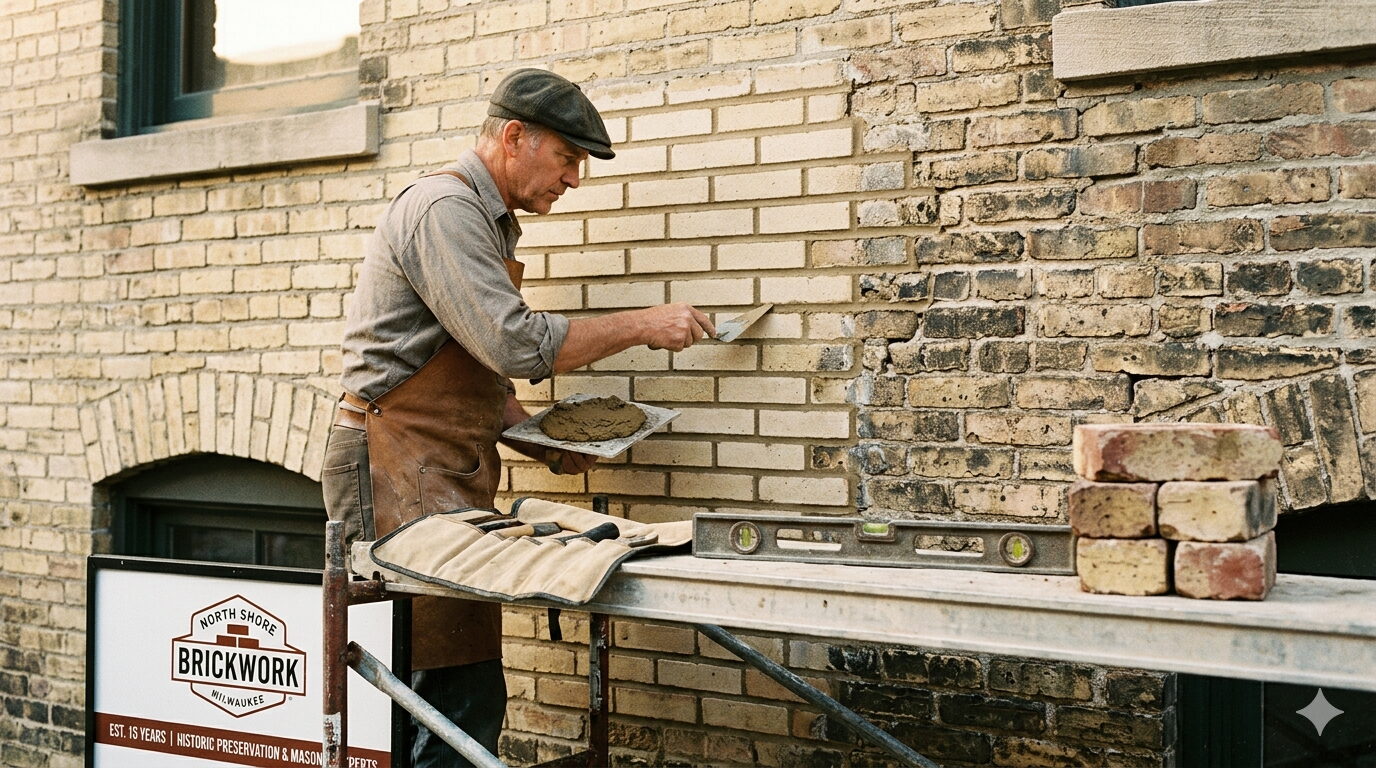
Historic restoration is one of the most rewarding — and most complex — masonry projects a property owner can undertake. It goes beyond routine repair, requiring deep knowledge of original construction methods, period-appropriate materials, and preservation standards.
Milwaukee is home to thousands of historic brick and stone buildings, from cream city brick mansions to Victorian-era commercial facades. These structures are irreplaceable cultural assets. When they need repair, the work must honour the original craftsmanship while meeting modern safety requirements.
In this guide, we cover everything property owners need to know about historic restoration — from understanding the process and legal requirements to selecting the right materials and budgeting effectively. Every recommendation comes from our team at North Shore Masonry, who perform historic restoration across Milwaukee daily.
What Is Historic Restoration?
Historic restoration is the process of returning a building to its appearance and condition from a specific period in history, using materials and techniques consistent with that era.
Unlike general renovation (which modernises a building) or rehabilitation (which adapts it for contemporary use), historic restoration aims to preserve and replicate the original construction as faithfully as possible.
For masonry, historic restoration typically involves repointing mortar joints with period-correct mortar, replacing damaged bricks with matching salvaged or custom-made units, restoring stone elements, and repairing or replicating original architectural details.
The National Park Service defines historic restoration as one of four treatment approaches for historic properties, alongside preservation, rehabilitation, and reconstruction. Each has distinct standards and applications.
Why Historic Restoration Matters for Property Owners
Historic restoration delivers tangible benefits beyond cultural preservation:
Property value increase: Properties in designated historic districts command 10–25% higher market values than comparable non-historic properties. Quality historic restoration amplifies this premium.
Tax incentives: Federal and state historic tax credits can offset 20–45% of qualified restoration costs. Wisconsin offers a 25% state income tax credit for historic rehabilitation.
Structural longevity: Historic restoration with correct materials (lime mortar, matching brick) extends building life by decades. Incorrect modern materials accelerate deterioration.
Community and tourism value: Restored historic buildings attract visitors, enhance neighbourhood character, and contribute to local economic vitality.
Cultural stewardship: Every historic building tells a story. Historic restoration preserves that narrative for future generations to experience firsthand.
Historic Restoration vs Renovation vs Rehabilitation
Understanding these distinctions helps property owners choose the right approach:
| Approach | Goal | Materials | Typical cost | Best for |
| Restoration | Compatible with modern and historic | Period-correct only | Highest | Landmark and museum buildings |
| Rehabilitation | Adapt for modern use while preserving character | Compatible modern and historic | Moderate–high | Most occupied historic buildings |
| Renovation | Modernise without preservation focus | Any modern materials | Varies | Non-designated buildings |
| Preservation | Maintain current condition, prevent further loss | Maintenance materials | Lowest | Stabilisation, mothballing |
For most Milwaukee property owners with historic buildings, rehabilitation is the most practical approach — it preserves historic character while allowing modern functionality. Full historic restoration is typically reserved for landmark-designated properties, museum buildings, and premium residential projects.
The 6-Step Historic Restoration Process
At North Shore Masonry, we follow a proven 6-step process for every historic restoration project:
Step 1 — Historical research and documentation: We research the building’s construction date, original materials, architectural style, and any previous modifications. This establishes the baseline for authentic restoration decisions.
Step 2 — Condition assessment and survey: A thorough physical assessment identifies all areas of damage, deterioration, and previous incorrect repairs. We test mortar composition, brick hardness, and moisture levels.
Step 3 — Permits, approvals, and compliance: We navigate historic preservation board requirements, obtain necessary permits, and prepare documentation for tax credit applications. This step prevents costly compliance issues later.
Step 4 — Restoration work with period materials: The actual restoration uses lime mortar, salvaged or custom-matched brick, and traditional masonry techniques. Every material is chosen for period accuracy and compatibility.
Step 5 — Quality review and documentation: Completed work is reviewed against preservation standards. Photographic documentation and material records are compiled for compliance files and future reference.
Step 6 — Long-term maintenance plan: We provide a maintenance schedule that protects the restoration investment for decades. Regular inspection and preventive care extend the life of restored masonry significantly.
💡 Why documentation matters
Thorough documentation of every historic restoration decision, material choice, and technique used creates a permanent record that protects the property owner. It satisfies preservation board requirements, supports tax credit applications, and provides a reference for future maintenance. We photograph every stage and provide a complete restoration report at project completion.
Materials Used in Historic Masonry Restoration
Material selection is the most critical aspect of historic restoration. Using the wrong materials causes more damage than leaving deteriorated elements in place.
Mortar: the most important material decision
Historic buildings (pre-1920) were built with lime mortar, not Portland cement. Using Portland cement on these structures is the most damaging mistake in historic restoration. Cement is harder than historic brick, traps moisture, and causes irreversible spalling within 3–5 years.
| Material | Correct for historic restoration | Incorrect (causes damage) |
| Mortar | NHL lime or Type O (1:2:9) | Type S, Portland cement, or Type N on soft brick |
| Brick | Matching the original profile exactly | Modern mass-produced brick |
| Stone | Same quarry source or closest match | Concrete substitute or mismatched stone |
| Sealant | Breathable masonry sealant | Non-breathable paint or coating |
| Cleaning | Low-pressure water, gentle detergent | High-pressure washing, acid washing |
| Joint profile | Matching original profile exactly | Modern profile on historic joints |
Sourcing period-appropriate brick
Matching historic brick requires finding salvaged brick from the same era and region, or commissioning custom-made brick to match the original dimensions, colour, and texture. In Milwaukee, cream city brick is particularly challenging to match due to its unique composition and limited salvage supply.
The National Trust for Historic Preservation provides comprehensive guidance on sourcing period-appropriate materials for historic restoration projects across the United States.
Legal Requirements for Historic Restoration
Historic restoration projects must comply with specific legal and regulatory frameworks:
Local historic designation
Properties in Milwaukee’s designated historic districts are subject to oversight by the Historic Preservation Commission (HPC). Any exterior alterations — including masonry repair — may require Certificate of Appropriateness (COA) approval before work begins.
The same process applies across the Chicago area. In Evanston, for example, exterior work on a designated landmark or district property that is visible from the public way needs a Certificate of Appropriateness before a building permit is issued, and the mortar, joint profile and brick match are part of that review. Our Evanston masonry page explains how we prepare that documentation.
Permit requirements
Historic restoration typically requires standard building permits plus additional preservation-specific approvals. Working without proper permits can result in fines, mandatory removal of non-conforming work, and loss of tax credit eligibility.
Secretary of the Interior’s Standards
Federal tax credit eligibility requires compliance with the Secretary of the Interior’s Standards for Rehabilitation. These 10 standards govern everything from material selection to design decisions and must be documented throughout the project.
Environmental regulations
Historic buildings may contain lead paint, asbestos, or other hazardous materials that require specialised handling during restoration. Environmental assessments may be required before work begins.
Historic Restoration Funding and Tax Incentives
Understanding available funding dramatically reduces the net cost of historic restoration:
| Incentive | Amount | Eligibility | Application |
| Federal Historic Tax Credit | 20% of qualified costs | Income-producing, National Register listed | NPS Part 1-2-3 application |
| Wisconsin State Tax Credit | 25% of qualified costs | Wisconsin historic designation | State historic preservation office |
| Combined federal + state | Up to 45% offset | Both designations, income-producing | Dual application process |
| Local preservation grants | Varies ($1,000–$50,000) | Local historic designation | Municipal preservation office |
| Facade improvement programs | Varies by municipality | Commercial properties in districts | Local economic development office |
A $100,000 historic restoration project on a qualifying income-producing property in Milwaukee could receive up to $45,000 in combined federal and state tax credits — reducing the net cost to $55,000.
💡 Tax credit tip
To qualify for federal and state historic tax credits, the restoration must follow the Secretary of the Interior’s Standards and be documented with before/during/after photographs plus material specifications. North Shore Masonry provides the required documentation as part of every historic restoration project. The application process takes 60–90 days, so plan ahead.
Common Challenges in Historic Restoration
Understanding the challenges of historic restoration helps you plan effectively:
1. Sourcing matching materials: Finding salvaged brick, stone, and hardware that matches the original can be time-consuming and expensive. Custom fabrication may be necessary.
2. Finding skilled craftsmen: True historic restoration requires masons trained in lime mortar techniques, traditional pointing methods, and period construction practices. These skills are specialised and not universally available.
3. Navigating preservation boards: The approval process for historic districts can take weeks to months. Detailed drawings, material specifications, and sample panels may be required before work can begin.
4. Balancing code compliance: Meeting modern building codes (fire safety, structural, accessibility) while maintaining historic authenticity requires creative solutions and experienced professionals.
5. Budget management: Historic restoration costs are less predictable than standard construction because hidden conditions are frequently discovered during work. A 15–25% contingency budget is essential.
6. Correcting previous bad repairs: Many historic buildings have been damaged by previous incorrect repairs (Portland cement on lime mortar buildings). Removing and correcting these repairs adds significant cost.
Historic Restoration Cost Guide 2026
Understanding historic restoration costs helps you budget realistically:
| Restoration type | Estimated cost | Includes |
| Mortar repointing (lime mortar) | $15–$50 per sq ft | NHL lime, colour matching, depth |
| Brick replacement (salvaged) | $30–$75 per brick | Sourcing, cutting in, mortar matching |
| Brick replacement (custom-made) | $50–$150 per brick | Custom fabrication, matching, install |
| Stone restoration | $25–$100 per sq ft | Cleaning, repair, Dutchman repair |
| Lintel restoration | $1,500–$5,000 per lintel | Period-correct replacement |
| Full facade restoration | $15,000–$75,000+ | Comprehensive masonry restoration |
| Ornamental detail restoration | $2,000–$15,000+ | Cornices, arches, decorative elements |
| Documentation and compliance | $1,000–$5,000 | Photo records, material specs, reports |
Historic restoration typically costs 30–60% more than standard masonry repair due to material sourcing, specialised techniques, and compliance requirements. However, tax credits can offset 20–45% of these costs, and the resulting property value increase often exceeds the investment.
Maintaining Your Historic Property After Restoration
A well-maintained historic restoration lasts generations. Follow these maintenance practices:
1. Annual inspection: Walk the full exterior twice per year, noting any new cracks, mortar erosion, spalling, or moisture signs. Document findings with photos.
2. Gentle cleaning only: Clean brick and stone with low-pressure water (under 500 PSI) and pH-neutral detergent. Never use high-pressure washing or acid-based cleaners on historic masonry.
3. Repoint as needed: Address mortar deterioration promptly with the same lime mortar used in the restoration. Small repairs prevent large-scale repointing.
4. Maintain drainage: Keep gutters clean, downspouts functional, and grading directing water away from walls. Moisture is the primary enemy of historic masonry.
5. Keep records: Maintain a file with restoration documentation, material specifications, and maintenance records. This protects your investment and supports future work.
Need Historic Restoration in Milwaukee?
North Shore Masonry provides expert historic restoration using period-correct lime mortar, matching brick, and traditional masonry techniques. We handle preservation board compliance, tax credit documentation, and long-term maintenance planning.
Contact North Shore Masonry today for a free historic restoration assessment.
FAQs | Historic Restoration
Q: What is historic restoration?
Historic restoration is the process of returning a building to its appearance and condition from a specific historical period using period-appropriate materials and techniques. For masonry, this means lime mortar, matching brick, and traditional craftsmanship.
Q: How is historic restoration different from renovation?
Restoration aims to replicate the original construction faithfully. Renovation modernises a building without preservation focus. Rehabilitation (the most common for occupied historic buildings) adapts for modern use while preserving historic character.
Q: What mortar should be used for historic restoration?
NHL lime mortar or Type O (1:2:9) for pre-1920 buildings. Never use Portland cement or Type S on historic brick. These hard mortars trap moisture and cause irreversible spalling on soft historic brick.
Q: How much does historic restoration cost?
Mortar repointing costs $15–$50 per sq ft with lime mortar. Full facade restoration ranges $15,000–$75,000+. Costs are 30–60% higher than standard repair but tax credits can offset 20–45%.
Q: Are there tax credits for historic restoration?
Yes. The federal historic tax credit covers 20% of qualified costs for income-producing properties listed on the National Register. Wisconsin offers an additional 25% state credit. Combined, these can offset up to 45% of restoration costs.
Q: Do I need permits for historic restoration?
Yes. Properties in designated historic districts typically require Certificate of Appropriateness (COA) approval from the Historic Preservation Commission plus standard building permits. Working without permits risks fines and loss of tax credit eligibility.
Q: What materials are used in historic masonry restoration?
NHL lime mortar, salvaged or custom-matched brick, compatible stone, breathable sealants, and period-appropriate joint profiles. The materials must match the original era in composition, appearance, and performance.
Q: Can wrong repairs damage historic buildings?
Yes. Portland cement mortar on lime-mortar buildings is the most common damaging repair. It traps moisture, causes brick spalling, and is harder than the brick. Correcting bad previous repairs is a high cost in many historic restoration projects.
Q: How do I find a qualified historic restoration contractor?
Look for contractors with specific historic restoration experience, knowledge of lime mortar techniques, and familiarity with preservation board requirements. Ask for references on similar historic projects and verify they understand the Secretary of the Interior’s Standards.
Q: How long does historic restoration take?
Timeline varies widely: small repointing projects take 1–2 weeks, full facade restoration takes 4–12 weeks, and major landmark restorations can take months. Add 4–8 weeks for preservation board approvals and permit processing.