Key Takeaway: Stone masonry restoration is not just repair work — it’s the preservation of history, artistry, and structural integrity. Expert craftsmanship is the difference between a restoration that lasts 100+ years and a patch job that fails within a decade.
Stone masonry restoration is the specialised process of repairing, preserving, and rebuilding stone structures to their original condition. It’s one of the most skilled trades in the construction industry, requiring a unique blend of technical knowledge, artistic ability, and deep respect for historical architecture.
Whether it’s a 19th-century limestone church, a sandstone commercial building, or a granite retaining wall, stone masonry restoration demands craftsmanship that modern mass-production simply cannot replicate.
In this guide, we explore why craftsmanship is the cornerstone of every successful stone masonry restoration project — from the traditional techniques that have been used for centuries to the modern technologies that enhance (but never replace) skilled hands.
What Is Stone Masonry Restoration?
Stone masonry restoration involves repairing deteriorated stonework while preserving the original character, materials, and construction methods of the structure. Unlike demolition and rebuilding, stone masonry restoration aims to retain as much original material as possible.
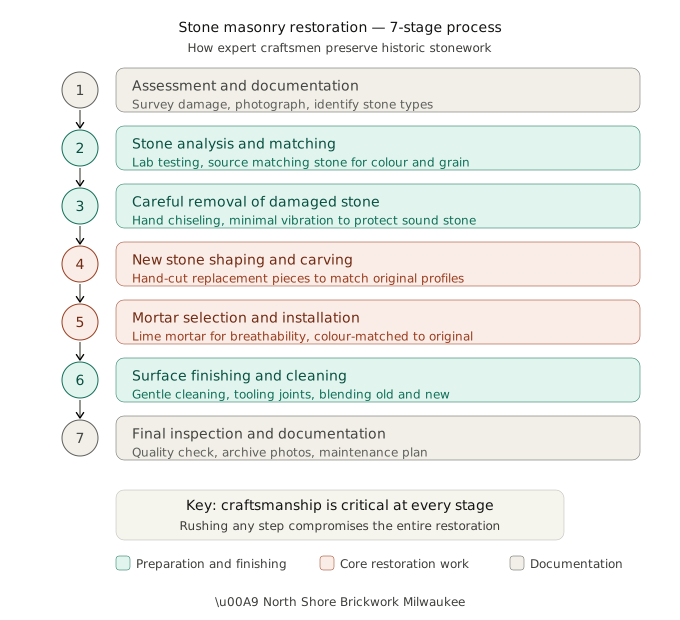
The process typically includes removing damaged stone, matching replacement stone for colour, grain, and composition, repointing mortar joints with historically appropriate mortar, and restoring carved or decorative elements to their original profiles.
According to the National Trust for Historic Preservation, stone masonry restoration is one of the most effective ways to extend the life of heritage buildings by 100+ years when performed correctly.
Why Craftsmanship Matters in Stone Masonry Restoration
Craftsmanship is the single most important factor in determining whether a stone masonry restoration project succeeds or fails. Here’s why:
Material knowledge: Every type of stone — limestone, sandstone, granite, marble — responds differently to tools, weather, and mortar. A skilled mason understands these differences intuitively and adjusts their approach accordingly.
Historical accuracy: Stone masonry restoration isn’t just about making something look new. It’s about matching the original mason’s intent — the tool marks, the joint profiles, the surface finish. Only experienced craftsmen can achieve this level of authenticity.
Structural integrity: Incorrect stone masonry restoration can actually accelerate deterioration. Using the wrong mortar (e.g., Portland cement on soft limestone) traps moisture and causes the stone to spall and crumble faster than if left unrepaired.
Longevity: A skilled stone masonry restoration lasts 50–100+ years. Poor workmanship fails within 5–15 years, requiring costly re-restoration that damages more original material.
💡 Expert Insight
At North Shore Masonry, we’ve corrected dozens of failed stone masonry restoration projects where contractors used modern cement mortar on historic limestone. The result was always the same: the stone deteriorated faster after the “restoration” than before. Craftsmanship means knowing what NOT to do as much as knowing what to do.
Stone masonry restoration process (7 stages):
Historical Significance of Stone Masonry
Stone masonry is one of humanity’s oldest building techniques. From the pyramids of Egypt to the cathedrals of medieval Europe, stone structures have defined civilisations and stood for millennia.
In Milwaukee and across Wisconsin, stone masonry has a rich heritage. Cream City brick, Lannon stone, and local limestone were used extensively in 19th and early 20th-century construction. Many of these buildings are now protected landmarks that require sensitive stone masonry restoration.
The craftsmen who built these structures were highly skilled artisans. Preserving their work through proper stone masonry restoration is not just a technical exercise — it’s an act of cultural stewardship that connects present communities to their past.
Traditional Techniques Used in Stone Masonry Restoration
The core techniques of stone masonry restoration have remained remarkably consistent for centuries. Here are the key methods skilled craftsmen use:
| Technique | Description | Best For |
| Hand chiseling | Shaping replacement stone to match the originals | Delicate historic work |
| Stone carving | Smoothing stone surfaces to match the original texture | Decorative elements, mouldings |
| Pointing chisel work | Raking and repointing mortar joints by hand | All stone masonry restoration |
| Rubbing and finishing | Smoothing stone surfaces to match original texture | Visible facades |
| Lime mortar application | Using NHL lime mortar for breathable joints | All historic stonework |
| Indent repair | Cutting out damaged sections and inserting new stone | Localised damage |
| Plastic repair | Using stone-dust mortar to fill small defects | Minor surface damage |
The International Council on Monuments and Sites (ICOMOS) recommends that stone masonry restoration should always prioritise the least invasive technique that achieves the required structural and aesthetic result.
Modern Technology in Stone Masonry Restoration
While traditional craftsmanship remains the foundation of stone masonry restoration, modern technology enhances the process in several important ways:
Technologies That Support (Not Replace) Craftsmanship
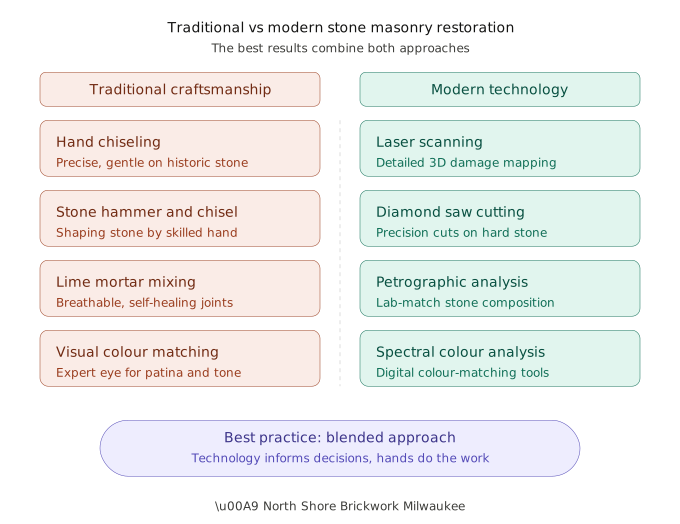
3D laser scanning: Creates precise digital models of existing structures, helping masons identify hidden damage and plan replacement pieces with millimetre accuracy.
Petrographic analysis: Laboratory testing identifies the exact mineral composition of original stone, enabling perfect material matching for stone masonry restoration projects.
Diamond saw cutting: Allows precision cuts on extremely hard stone types like granite, where hand tools alone would be impractical.
Digital colour matching: Spectral analysis tools help match the colour and patina of replacement stone to weathered originals — supporting the mason’s trained eye.
Drone surveying: Provides safe access to high or difficult-to-reach areas for initial condition assessment before scaffolding is erected.
The key principle is that technology informs the craftsman’s decisions — it never replaces their hands. The best stone masonry restoration projects combine both approaches seamlessly.
Traditional vs modern techniques in stone masonry restoration:
Common Challenges in Stone Masonry Restoration Projects
Every stone masonry restoration project presents unique challenges. Here are the most common issues craftsmen face:
Environmental Damage
Freeze-thaw cycles are the primary cause of stone deterioration in Milwaukee’s climate. Water enters micro-cracks, freezes, expands, and gradually breaks the stone apart from within. Pollution and acid rain accelerate surface erosion on limestone and sandstone.
Previous Poor Repairs
Many buildings have been “repaired” with inappropriate materials — Portland cement mortar on soft stone, mismatched replacement stone, or surface sealants that trap moisture. Correcting these failed repairs is often more challenging than addressing the original damage.
Stone Matching
Finding replacement stone that matches the original in colour, grain, texture, and weathering characteristics is one of the most difficult aspects of stone masonry restoration. Quarries may have closed decades ago, requiring craftsmen to source stone from alternative locations or use skilled colour-matching techniques.
Structural Movement
Settlement, thermal expansion, and seismic activity can cause cracks and displacement that affect the entire structure. Stone masonry restoration must address these root causes, not just the visible symptoms.
Stone Types and Their Restoration Requirements
| Stone Type | Common Issues | Mortar Type | Restoration Difficulty |
| Limestone | Erosion, spalling, acid rain damage | NHL lime mortar | Moderate |
| Sandstone | Surface crumbling, salt crystallisation | NHL lime mortar | Moderate–High |
| Granite | Cracking, joint failure | Type N or lime | High (hardness) |
| Marble | Staining, surface sugaring | NHL lime mortar | High (precision) |
| Slate | Delamination, flaking | Lime mortar | Moderate |
| Lannon stone | Weathering, iron staining | NHL lime mortar | Moderate |
Each stone type in stone masonry restoration demands specific tools, mortar mixes, and finishing techniques. Using the wrong approach on any stone type can cause irreversible damage.
Case Studies: Successful Stone Masonry Restoration Projects
Notre-Dame Cathedral, Paris (2019–Ongoing)
After the devastating fire of 2019, the restoration of Notre-Dame became the world’s most prominent stone masonry restoration project. Craftspeople from across France joined forces to replace damaged limestone blocks using traditional hand-carving techniques, guided by 3D laser scans taken before the fire.
St. Paul’s Cathedral, London
The ongoing conservation of St. Paul’s involves meticulous stone masonry restoration of Portland stone facades. The project demonstrates how expert craftsmanship preserves intricate carvings, mouldings, and sculptural elements that machine work simply cannot replicate.
Milwaukee Historic Buildings
Across Milwaukee, cream city brick and Lannon stone buildings from the 1850s–1920s era require ongoing stone masonry restoration. At North Shore Masonry, we’ve restored facades on landmark commercial buildings, residential brownstones, and historic churches — always using lime mortar and hand-matched replacement stone.
💡 Our Restoration Philosophy
Every stone masonry restoration project tells a story. Our job is to honour the original craftsmen’s work while ensuring the structure stands strong for another century. We never use Portland cement on historic stone, and we always source the closest possible material match.
How to Choose a Stone Masonry Restoration Contractor
Choosing the right contractor for stone masonry restoration is critical. Here’s what to look for:
1. Proven historic restoration experience: Ask for a portfolio of completed stone masonry restoration projects, not just general bricklaying work.
2. Knowledge of lime mortar: Any contractor who suggests using Portland cement on historic stone should be avoided. Lime mortar expertise is non-negotiable.
3. Material sourcing capability: Can they source matching replacement stone? Do they have quarry relationships?
4. References from heritage organisations: Recommendations from historical societies or preservation boards indicate genuine expertise.
5. Detailed written scope: A professional stone masonry restoration contractor provides itemised scopes covering stone type, mortar mix, techniques, and timeline.
6. Insurance and licensing: Ensure the contractor carries adequate liability insurance and holds relevant masonry licenses.
Need Stone Masonry Restoration in Milwaukee?
North Shore Masonry provides expert stone masonry restoration for historic, residential, and commercial properties across southeastern Wisconsin. Free assessments. No Portland cement on historic stone. Ever.
Contact North Shore Masonry today for a free restoration assessment.
FAQs | Stone Masonry Restoration
Q: What is stone masonry restoration?
Stone masonry restoration is the process of repairing, conserving, and rebuilding deteriorated stonework while preserving the original character, materials, and construction methods. It differs from replacement in that the goal is to retain as much original material as possible.
Q: How long does stone masonry restoration last?
When performed correctly with appropriate lime mortar and matching stone, a quality stone masonry restoration can last 50–100+ years. Poor workmanship using incorrect materials may fail within 5–15 years.
Q: What mortar should be used for stone masonry restoration?
Natural hydraulic lime (NHL) mortar is the industry standard for historic stone masonry restoration. Portland cement is too hard for most historic stone and traps moisture, accelerating deterioration.
Q: How much does stone masonry restoration cost?
Costs vary widely based on stone type, damage severity, and access. Small repairs may cost $500–$2,000. Large facade restorations can range from $10,000 to $100,000+. Historic projects with carving work command premium pricing.
Q: Can damaged stone be repaired or must it be replaced?
Many damaged stones can be repaired using indent techniques (cutting out the damaged section and inserting new stone) or plastic repair (filling small defects with stone-dust mortar). Full replacement is only necessary when the stone is structurally compromised.
Q: Why is craftsmanship important in stone masonry restoration?
Craftsmanship determines whether the restoration is structurally sound, historically accurate, and aesthetically seamless. Machine work cannot replicate the subtle tool marks, profiles, and textures that define historic stonework.
Q: What is the difference between restoration and conservation?
Restoration returns a structure to a specific historical appearance, potentially replacing lost elements. Conservation focuses on stabilising and preserving what exists, minimising new additions. Both require expert stone masonry restoration skills.
Q: How does weather affect stone masonry restoration?
Freeze-thaw cycles, rain, extreme heat, and humidity all impact stone masonry restoration. Work should be performed in mild conditions (5–25°C) with no rain forecast. Lime mortar requires extended curing protection.
Q: Can modern technology replace traditional craftsmanship?
No. Modern technology enhances stone masonry restoration by improving assessment accuracy and material matching, but the actual restoration work — chiseling, carving, mortar application, and finishing — requires skilled human hands.
Q: How do I know if my building needs stone masonry restoration?
Signs include crumbling or cracking mortar joints, spalling stone surfaces, loose or missing stones, water staining on interior walls, and visible erosion. An expert assessment can determine the scope of stone masonry restoration needed.