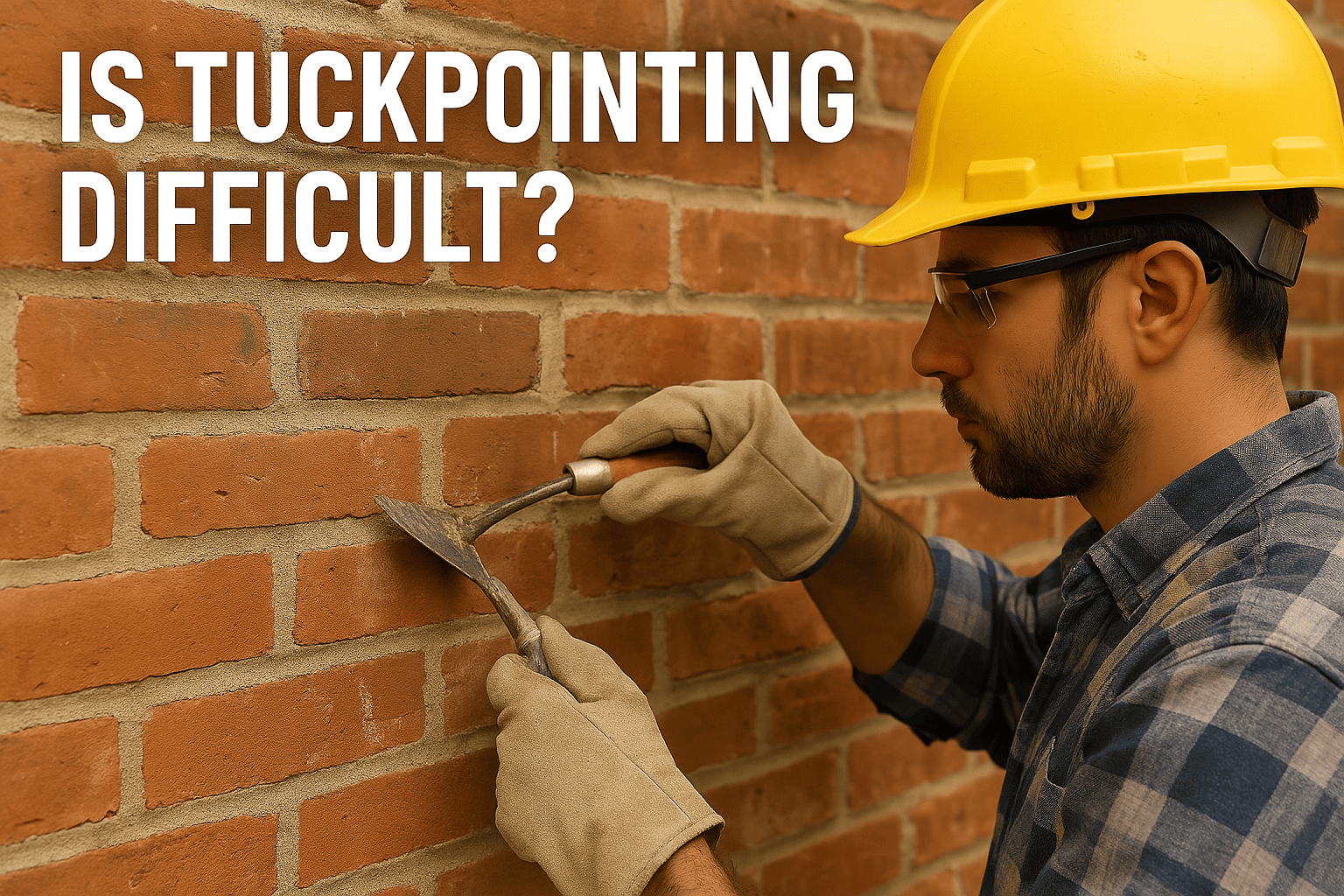
Is tuckpointing difficult? It’s the question every homeowner asks after watching a YouTube tutorial and thinking, “I could do that.” The honest answer is yes — tuckpointing is significantly more difficult than it appears, and the gap between amateur and professional results is wider than almost any other home maintenance task.
The reason is simple: tuckpointing combines physical labour, material science, visual artistry, and structural knowledge into a single process. Each component has its own learning curve, and a mistake in any one of them can compromise the entire repair.
In this guide, we break down exactly what makes tuckpointing difficult, rate the difficulty of each step, and help you realistically assess whether your project is within DIY reach. Every assessment is based on our daily experience at North Shore Brickwork Milwaukee.
Is Tuckpointing Difficult? (The Honest Answer)
The straightforward answer to “is tuckpointing difficult?” is yes — but the difficulty depends on the specific project:
| Project type | Difficulty level | DIY realistic? |
| Small patch, ground level, modern brick | Moderate | Yes, with preparation |
| Single wall face, ground level | Difficult | Possible with experience |
| Two-story or higher wall | Very difficult + safety risk | No |
| Chimney tuckpointing | Very difficult + safety risk | No |
| Historic or soft brick | Expert-level | No |
| Colour-matched or decorative tuckpointing | Expert-level | No |
| Cream city brick (Milwaukee) | Expert-level | No |
The difficulty level of tuckpointing doesn’t change with confidence or enthusiasm. It changes with the specific brick type, project scope, height, and material requirements. Understanding this distinction is what separates realistic self-assessment from costly overconfidence.
Difficulty Rating for Each Tuckpointing Step
Understanding why tuckpointing is difficult requires examining each step individually:
| Step | Task | Difficulty | What makes it hard |
| 1 | Raking old mortar to correct depth | Difficult | Controlling depth without brick damage |
| 2 | Cleaning and brushing joints | Easy | Physical effort, time-consuming |
| 3 | Dampening joints correctly | Easy | Timing and consistency |
| 4 | Selecting correct mortar type | Expert | Wrong choice causes brick damage |
| 5 | Mixing mortar to right consistency | Moderate | Water ratio is critical |
| 6 | Applying mortar in layered compression | Difficult | Dexterity on vertical surfaces |
| 7 | Joint profiling and finishing | Difficult | Timing, tool control, visual precision |
| 8 | Colour matching | Expert | Sand, pigment, curing changes |
| 9 | Curing protection | Moderate | Weather monitoring, 3–7 day commitment |
Steps 1, 6, and 7 are where most DIY attempts fail. These require the physical skill and muscle memory that only develop through repetitive practice — exactly the kind of experience professional masons build over years.
6 Reasons Tuckpointing Is Harder Than It Looks
Here’s what makes tuckpointing difficult beyond the basic process:
1. Mortar hardens fast: You have a 30–60 minute working window from mixing to application. Once mortar begins to set, it cannot be reworked. Working too slowly means wasted material and inconsistent results.
2. Vertical application defies gravity: Pressing mortar into horizontal joints is manageable, but vertical joints (perpends) require technique to prevent mortar from falling out before it sets. This is the skill that takes months to develop.
3. Depth control is invisible: You cannot see whether you’ve raked to the correct 15–25 mm depth without measuring. Shallow raking (the most common DIY error) produces repairs that fail in 1–2 winters.
4. Colour changes during curing: Fresh mortar looks dramatically different from cured mortar. A seemingly perfect colour match on day 1 may look completely wrong on day 3. This leads DIYers to panic-adjust, creating worse inconsistency.
5. Physical endurance is underestimated: Tuckpointing requires hours of sustained overhead arm work, precise hand movements, and kneeling or crouching. Fatigue leads to rushing, which leads to errors.
6. Mistakes are invisible at first: A tuckpointing repair can look perfect on completion day but fail months later when shallow raking, wrong mortar type, or improper curing reveal themselves through cracking, pop-outs, or spalling.
The Brick Industry Association confirms that tuckpointing difficulty is frequently underestimated by homeowners, leading to the highest failure rate of any common masonry repair when attempted without professional training.
💡 Why it looks easy on video
Professional tuckpointing appears effortless because the mason has performed the same motions thousands of times. The hand movements, tool angles, mortar consistency judgement, and timing decisions have become automatic through years of practice. What you’re seeing is mastery — not simplicity. It’s the same reason a professional chef makes cooking look easy while a beginner burns the sauce.
The Physical Demands That Make Tuckpointing Difficult
One aspect of “is tuckpointing difficult?” that surprises most people is the physical intensity:
Upper body endurance: Raking, brushing, and pointing require sustained arm and shoulder work at or above head height. Most DIYers experience significant fatigue within 1–2 hours.
Hand and wrist precision: Pointing trowel work demands fine motor control under physical strain. As fatigue builds, precision drops and mortar application becomes inconsistent.
Kneeling and crouching: Lower wall courses require extended periods of kneeling. Upper courses require overhead work. Both are physically demanding for extended periods.
Working in heat: Summer tuckpointing in Milwaukee means working in 25–35°C temperatures while mortar sets faster, shortening the working window and increasing physical urgency.
Scaffolding and ladder work: Above ground level, physical difficulty multiplies. Carrying tools and mortar while maintaining balance on scaffolding adds significant strain and safety risk.
Skills Required for Quality Tuckpointing
Beyond the physical demands, tuckpointing is difficult because it requires multiple distinct skill sets simultaneously:
Material science
Selecting the correct mortar type (Type N, O, S, or NHL lime) requires understanding the relationship between mortar hardness and brick hardness. This knowledge prevents the most damaging tuckpointing errors.
Tool proficiency
Mortar rakers, pointing trowels, joint finishers, and hawks each require specific handling techniques. An angle grinder in untrained hands can crack bricks. A trowel at the wrong angle produces weak joints.
Visual judgement
Colour matching, consistency assessment, and curing readiness are all visual skills that develop through experience. These judgement calls cannot be learned from a video — they require hands-on repetition.
Timing and pacing
Mortar sets on a clock. Working too slowly wastes material. Working too fast produces sloppy results. Finding the right pace for your specific mortar and weather conditions is a skill that takes months to calibrate.
How Long Does It Take to Learn Tuckpointing?
If you’re wondering “is tuckpointing difficult to learn?” here are realistic timelines:
| Skill level | Time to achieve | What you can do | Quality level |
| First attempt | Day 1 | Small test patch | Unpredictable, likely poor |
| Basic competence | 6–12 months of practice | Simple ground-level patches | Acceptable for hidden areas |
| Solid intermediate | 1–2 years of regular work | Single-wall residential | Good, consistent results |
| Professional quality | 2–3 years full-time | All residential projects | Matching existing work seamlessly |
| Mastery | 5+ years dedicated | Historic, decorative, any brick type | Invisible repairs, artisan level |
The Mason Contractors Association of America requires a minimum of 2–3 years of supervised apprenticeship before recognising a mason as journeyman-level. This timeline reflects the genuine learning curve that makes tuckpointing difficult to master.
What Makes Milwaukee Tuckpointing Especially Challenging
Milwaukee’s specific conditions add layers of difficulty beyond the standard “is tuckpointing difficult?” question:
70+ freeze-thaw cycles test every repair: DIY mortar mistakes that might survive 5 years in Georgia fail in 1–2 Milwaukee winters. The margin for error is smaller here than almost anywhere else.
Cream city brick demands expert mortar selection: Milwaukee’s iconic cream city brick is softer than standard red brick. Using the wrong mortar type causes irreversible spalling. This single factor makes Milwaukee tuckpointing more difficult than in cities with harder brick.
Short working season: Tuckpointing can only be done when temperatures stay above 5°C for 7+ consecutive days. Milwaukee’s reliable season is April through October, creating time pressure and reducing the opportunity for DIY practice.
Road salt accelerates failure: Any weakness in DIY mortar is exposed faster by Milwaukee’s heavy road salt use, which erodes ground-level joints aggressively.
💡 A local mason’s perspective
Our apprentice masons spend their first 6 months mixing mortar, carrying materials, and observing journeymen before touching a pointing trowel on a real project. Even then, their first year of tuckpointing work is supervised and reviewed daily. Is tuckpointing difficult? Our training program says yes — and we train people who have chosen masonry as a career.
When Tuckpointing Difficulty Exceeds DIY Ability
The difficulty level crosses from “challenging but possible” to “professional required” in these scenarios:
Any work above 2 metres: The combination of height, balance, heavy tools, and precision work creates unacceptable safety risk for non-professionals.
Soft or historic brick (pre-1950): The mortar selection margin is too narrow for trial-and-error. Wrong choice equals permanent brick damage.
Full wall or larger areas: Maintaining consistent colour, depth, and joint profile across a large area requires the stamina and muscle memory only professionals possess.
Structural concerns: Cracks wider than 3 mm, bowing walls, or failed lintels indicate structural issues that require professional assessment, not DIY mortar repair.
Decorative tuckpointing: The dual-mortar technique with contrasting lines requires the highest skill level. This is artisan work that takes years to master.
When previous DIY has failed: Correcting a failed DIY job is harder than the original work because the wrong mortar must be carefully removed before correct materials can be applied.
How Professional Masons Make Tuckpointing Look Easy
Understanding what professionals bring answers the deeper question behind “is tuckpointing difficult?”:
Muscle memory: After thousands of hours, the hand movements for raking, pressing, and profiling become automatic. The mason’s hands know the correct pressure and angle without conscious thought.
Material intuition: Experienced masons can assess mortar consistency by feel, judge curing readiness by touch, and estimate colour match by eye. These intuitive skills cannot be taught in a tutorial.
Efficiency: A professional completes in 4 hours what takes a DIYer 16+ hours. This isn’t just speed — it’s the elimination of hesitation, rework, and wasted material that comes with experience.
Problem-solving: Unexpected conditions (hidden moisture, inconsistent brick hardness, previous incorrect repairs) are routine for professionals. Each requires an on-the-spot solution that experience provides.
Tool mastery: Professional tools in trained hands produce results that consumer tools in untrained hands cannot match, regardless of effort or enthusiasm.
The ASTM C270 mortar standard exists specifically because correct mortar selection is too complex and consequential for guesswork. Professional masons reference this standard on every project.
Skip the Difficulty — Hire Experts Who Make It Look Easy
North Shore Brickwork’s masons bring years of training and thousands of completed projects to every job. We make tuckpointing look easy because we’ve spent years mastering it.
Contact North Shore Brickwork today for a free tuckpointing assessment.
FAQs | Is tuckpointing difficult?
Q: Is tuckpointing difficult?
Yes. Tuckpointing requires precise mortar removal, correct mortar type selection, expert application technique, colour matching, and proper curing. Small ground-level patches on modern brick are manageable, but most tuckpointing projects require professional skill for lasting results.
Q: How hard is tuckpointing compared to other home repairs?
Tuckpointing is among the most difficult common home maintenance tasks. It ranks harder than painting, basic plumbing, or drywall repair because it combines physical labour, material science, and visual artistry with zero tolerance for key errors.
Q: Can a beginner do tuckpointing?
A beginner can attempt a small ground-level patch on modern hard brick with careful preparation, correct mortar, and willingness to test first. Anything beyond this scope has a high failure rate for beginners and risks causing expensive brick damage.
Q: What is the hardest part of tuckpointing?
Mortar type selection (wrong choice causes brick spalling), raking to correct depth without damaging bricks, and achieving a consistent colour match are the three hardest aspects. All three require experience that only develops through practice.
Q: How long does it take to learn tuckpointing?
Basic competence takes 6–12 months of regular practice. Professional quality requires 2–3 years of full-time work. Mastery-level skill for historic and decorative work takes 5+ years. The MCAA requires 2–3 years of apprenticeship before journeyman certification.
Q: Why does professional tuckpointing look so easy?
Professional masons have performed the same movements thousands of times, developing muscle memory, material intuition, and timing that makes complex work appear effortless. What looks simple is mastery, not simplicity.
Q: Is tuckpointing harder in Milwaukee?
Yes. Milwaukee’s 70+ freeze-thaw cycles, soft cream city brick, heavy road salt, and short working season make tuckpointing more difficult and less forgiving of errors than in milder climates.
Q: What tools make tuckpointing easier?
Professional tools like oscillating multi-tools (for precise raking), narrow pointing trowels, mortar bags, and quality joint finishers improve results significantly. However, tools don’t replace the skill and experience needed to use them effectively.
Q: Is tuckpointing difficult on chimneys?
Chimney tuckpointing is among the most difficult tuckpointing scenarios due to height, wind exposure, scaffolding requirements, flashing complexity, and the structural importance of chimney integrity. It should always be done by professionals.
Q: Should I attempt tuckpointing myself even though it’s difficult?
Only if your project is a small ground-level patch on modern hard brick, you have the correct mortar type, and you’re willing to test a sample area first. For all other scenarios, the difficulty level and risk of costly damage make professional tuckpointing the better investment.