Professional Concrete Repair and Restoration for Residential, Commercial, and Multi-Unit Properties
Concrete is one of the most common structural materials in any building’s exterior. It forms steps, foundations, lintels, balconies, sidewalks, retaining walls, and facade elements. When concrete deteriorates, the damage is rarely cosmetic. Spalling, cracking, and delamination expose embedded steel reinforcement to moisture, accelerating corrosion that weakens the structure from the inside out.
At North Shore Masonry, we provide concrete repair and restoration services for property owners, condo associations, commercial property managers, and homeowners across Chicago, Milwaukee, Denton TX, and Fort Wayne IN. With over 47 years as a masonry contractor and MCAA certification, we diagnose the root cause of concrete failure, not just the visible surface damage, and execute repairs that restore both structural integrity and appearance.
Our concrete work is frequently part of larger building restoration projects where concrete repairs are coordinated with tuckpointing, lintel replacement, and waterproofing. But we also handle standalone concrete repair projects when the damage is isolated to specific elements.
What Causes Concrete to Fail?
Concrete is durable, but it is not permanent. Understanding what causes concrete deterioration helps property owners recognize problems early and make informed decisions about repair timing and scope.
Freeze-Thaw Cycling
Water penetrates concrete’s porous surface, and when temperatures drop below freezing, that water expands. Each freeze-thaw cycle pushes the concrete apart slightly more. Over dozens of Chicago and Milwaukee winters, this process produces surface scaling, cracking, and eventually full spalling where chunks of concrete break away from the structure. This is the single most common cause of concrete failure in our Midwest markets.
Rebar Corrosion and Expansion
Reinforcing steel (rebar) inside concrete corrodes when moisture reaches it through cracks or insufficient concrete cover. Rust occupies up to six times the volume of the original steel, creating internal pressure that fractures the surrounding concrete from within. The result is cracking, delamination, and eventually exposed rebar, a structural and safety concern that requires immediate attention.
Carbonation
Over time, carbon dioxide from the atmosphere reacts with calcium hydroxide in the concrete, lowering the pH of the material. This process, called carbonation, removes the alkaline protection that prevents embedded steel from corroding. Once carbonation reaches the rebar depth, corrosion begins even without visible cracking on the surface.
Deicing Salt Damage
Deicing salts applied to steps, sidewalks, and driveways in winter accelerate concrete deterioration. Salt increases the number of freeze-thaw cycles at the surface and introduces chlorides that penetrate to the rebar level, triggering corrosion. This is especially common on Chicago residential steps, front stoops, and sidewalks where salt application is heaviest.
Foundation Movement and Settlement
In North Texas, expansive clay soils absorb moisture and swell, then shrink during dry periods. This cyclical soil movement creates foundation settlement that produces cracking in concrete walls, slabs, and structural elements. Denton and surrounding communities experience this pattern regularly, and the resulting concrete damage often accompanies stair-step cracking in adjacent brickwork.
Poor Original Construction
Concrete that was mixed with too much water, cured too quickly, or placed with insufficient rebar cover fails prematurely. Inadequate concrete cover over reinforcing steel is a common problem in buildings from the mid-20th century. The thin layer of concrete protecting the rebar carbonates and cracks within decades rather than the 50+ year lifespan of properly placed concrete.
Our Concrete Repair and Restoration Services
We provide a full range of concrete repair services for exterior structural elements. Each repair begins with a diagnostic assessment to determine the cause and extent of deterioration, because patching over active corrosion or unaddressed moisture intrusion guarantees the repair will fail.
Concrete Step and Stoop Repair
Front steps and stoops are among the most visible and heavily used concrete elements on any property. They take direct exposure to weather, foot traffic, and deicing salt. We repair spalled and cracked steps through patching, resurfacing, or full replacement depending on the severity of damage. For severely deteriorated steps where the structure is compromised, we demolish and rebuild with properly reinforced concrete, correct drainage slope, and appropriate finish.
This is one of the most common concrete repairs we perform on Chicago single-family homes, two-flats, and greystones where original concrete steps from the 1920s through 1960s have reached the end of their service life.
Foundation and Structural Concrete Repair
Foundation walls, grade beams, and structural concrete elements develop cracks from settlement, soil pressure, thermal cycling, and rebar corrosion. We assess crack patterns to determine whether the issue is cosmetic, structural, or actively progressing. Repair methods include epoxy injection for structural crack bonding, routing and sealing for non-structural cracks, and partial removal and replacement for sections with severe delamination or corrosion damage.
Concrete Lintel Repair and Replacement
Many older buildings use poured concrete lintels above windows and doors rather than steel angles. These concrete lintels develop cracks and spall when internal rebar corrodes and expands. We repair or replace deteriorated concrete lintels, restoring the structural support above openings and preventing further damage to the surrounding masonry. This work is often coordinated with steel lintel replacement on the same building where both types of lintels are present.
Balcony and Slab Edge Repair
Balconies, canopies, and slab edges on multi-story buildings are prone to spalling and delamination at their exposed edges where moisture penetrates most readily. We remove deteriorated concrete, treat or replace corroded reinforcing steel, and restore the slab edge with repair mortar matched to the existing profile. For condo associations and commercial buildings, this work is critical for both structural safety and code compliance.
Concrete Facade and Wall Repair
Buildings with concrete facade panels, precast elements, or poured concrete walls develop surface spalling, cracking, and joint failure over time. Our repair scope includes removing loose and delaminated material, treating exposed reinforcement, patching with compatible repair mortars, and sealing joints to prevent future water infiltration. This work is frequently part of a broader building restoration scope that also addresses masonry, caulking, and waterproofing.
Sidewalk and Flatwork Repair
Cracked and heaved sidewalks, walkways, and aprons create trip hazards and liability exposure. We repair or replace damaged sections, matching existing grades and finishes. For commercial properties and condo associations, maintaining safe, level walkways is both a practical necessity and a legal responsibility.
Retaining Wall Repair
Concrete retaining walls develop cracks, lean, and displacement from soil pressure, poor drainage, and freeze-thaw damage. We assess the wall’s structural condition and perform repairs ranging from crack injection and surface restoration to partial rebuilds where the wall has shifted beyond correctable limits.
Concrete Resurfacing and Protective Coatings
For concrete surfaces that are structurally sound but have surface deterioration, scaling, or cosmetic damage, resurfacing with a bonded overlay restores a smooth, durable finish without full replacement. We also apply breathable sealers and protective coatings to extend the life of both new and repaired concrete, particularly on horizontal surfaces exposed to weather and deicing chemicals.
Our Concrete Repair Process
Every concrete repair project follows a systematic approach to ensure the repair addresses the cause of failure, not just the visible symptoms.
1. Assessment and Diagnosis
We inspect the concrete element to determine the type, cause, and extent of deterioration. This includes visual examination, sounding (tapping the surface to detect delamination beneath intact-looking concrete), and evaluation of crack patterns and moisture paths. For larger projects, we document conditions with photographs and prepare a detailed scope of work.
2. Concrete Removal
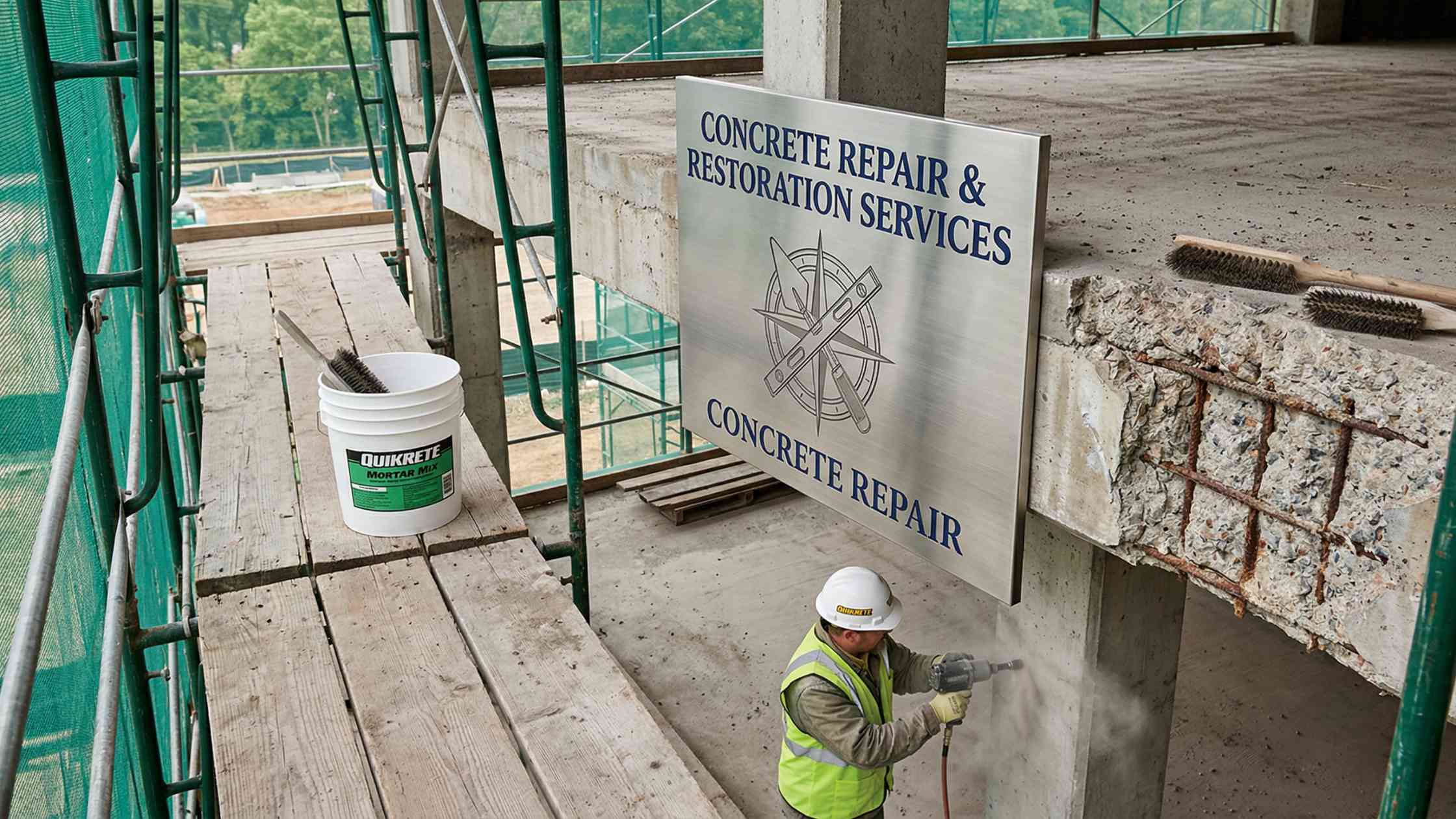
Deteriorated, delaminated, and unsound concrete is removed to expose a solid substrate for the repair material to bond to. This step is critical. Applying repair material over compromised concrete guarantees failure. We use pneumatic chipping hammers, saw cutting, and hand tools as appropriate for the element and access conditions.
3. Reinforcement Treatment
Exposed rebar is cleaned of rust and corrosion using wire wheels and mechanical cleaning. If the steel has lost significant cross-section to corrosion, supplemental reinforcement is installed. The cleaned steel is coated with a corrosion-inhibiting primer before repair material is placed, preventing future corrosion from restarting at the repair boundary.
4. Repair Material Placement
We select repair mortars and concrete mixes compatible with the existing material. Compatibility matters in both strength and thermal behavior. Repair material that is significantly harder or more rigid than the surrounding concrete will create stress concentrations that cause new cracking at the repair edges. We apply material in layers as needed, ensuring proper bonding, consolidation, and profile matching.
5. Finishing and Curing
Repair surfaces are finished to match the existing texture and profile. Proper curing is essential for concrete repair materials to achieve full strength and durability. We protect fresh repairs from premature drying, freezing, and traffic until the material has cured adequately.
6. Sealing and Protection
After repairs are complete and cured, we apply sealers or waterproofing treatments as appropriate to protect the restored surface from future moisture penetration. Horizontal surfaces like steps, balconies, and sidewalks benefit most from protective sealers that reduce water absorption and salt penetration.
Concrete Challenges by Market
Concrete deterioration patterns vary significantly by climate and geography. Our experience across four markets means we understand the specific failure modes that affect properties in each region.
Chicago and the North Shore
Chicago’s extreme freeze-thaw cycling is the primary driver of concrete failure. Steps, stoops, sidewalks, and lintels on buildings from the early to mid-1900s are at or past their expected service life. Deicing salt compounds the damage. Concrete balcony and slab edge repairs are common on mid-rise condo buildings throughout Lincoln Park, Lakeview, Uptown, and the near North suburbs like Evanston, Wilmette, and Skokie. See our full Chicago service area.
Milwaukee
Milwaukee shares Chicago’s freeze-thaw challenges with the added moisture load from Lake Michigan proximity. Older residential concrete in neighborhoods like Bay View, Riverwest, and the East Side shows heavy scaling and rebar-driven spalling. Commercial properties along the lakefront corridor face accelerated carbonation from moisture exposure. See our full Milwaukee service area.
Denton and North Texas
Freeze-thaw is less frequent in North Texas, but expansive clay soils cause foundation-related concrete cracking that Midwest properties rarely experience. Extreme summer heat accelerates carbonation and can cause thermal cracking in exposed slabs. Concrete repairs in Denton and surrounding communities often involve addressing both the concrete damage and the underlying soil movement that caused it. See our full Denton service area.
Fort Wayne
Fort Wayne’s climate produces freeze-thaw damage similar to Chicago and Milwaukee, with heavy deicing salt use on residential and commercial properties during long Indiana winters. Older downtown commercial buildings and residential neighborhoods in the Fort Wayne service area show the same rebar corrosion and spalling patterns common across the Midwest.
Signs Your Concrete Needs Repair
Concrete deterioration is often progressive. Small cracks and surface scaling can develop into structural problems if left unaddressed. Schedule a concrete assessment if you notice:
- Spalling: pieces of concrete breaking or flaking away from the surface, exposing aggregate or reinforcing steel
- Cracking: visible cracks in steps, walls, foundations, or lintels, especially cracks that are widening over time
- Delamination: hollow-sounding areas when the surface is tapped, indicating the concrete has separated internally even though the surface appears intact
- Exposed rebar: reinforcing steel visible through the concrete surface, with rust staining on surrounding areas
- Surface scaling: the top layer of concrete flaking or peeling away, common on horizontal surfaces exposed to deicing salt
- Heaving or settlement: concrete slabs, steps, or sidewalks that have shifted, tilted, or become uneven
- Water staining beneath concrete elements: rust-colored drip marks on walls below balconies, lintels, or slab edges, indicating active corrosion inside the concrete
- Efflorescence: white mineral deposits on the concrete surface indicating moisture is moving through the material
Early repair is almost always more cost-effective than waiting. A small patch today prevents a full replacement next year.
Why North Shore Masonry for Concrete Repair
- 47+ years in the masonry and concrete trade. We have repaired and restored concrete on every type of structure from single-family homes to multi-story commercial buildings since 1978.
- MCAA Certified. Our Mason Contractors Association of America certification reflects professional standards in both masonry and concrete work.
- Root-cause diagnosis, not surface patches. We identify why the concrete failed before deciding how to fix it. Patching over active corrosion or moisture intrusion wastes your money.
- Coordinated with masonry work. When concrete repairs are part of a larger restoration, we handle both trades with a single crew. No coordination gaps between separate contractors.
- 2-year labor and material warranty. Every concrete repair project is backed by our written warranty.
- Four markets, regional expertise. We understand the specific climate, soil, and construction patterns that drive concrete failure in Chicago, Milwaukee, Denton, and Fort Wayne.
Frequently Asked Questions
What is the difference between concrete repair and concrete replacement?
Concrete repair restores a structurally sound element by removing deteriorated material, treating reinforcement, and patching with compatible repair mortar. Replacement involves demolishing the entire element and pouring new concrete. Repair is appropriate when the majority of the concrete is sound and the damage is localized. Replacement is necessary when deterioration is too widespread for patching to be cost-effective or structurally reliable.
Can you repair concrete in winter?
Some concrete repairs can be performed in cold weather with appropriate material selection, heated enclosures, and curing protection. However, large pours and exposed flatwork are best scheduled for warmer months when temperatures consistently stay above 40 degrees F. We advise on timing during the scoping phase to ensure the best long-term result.
How long do concrete repairs last?
Properly executed concrete repairs using compatible materials and correct surface preparation typically last 15 to 25 years or longer. The key factors are thorough removal of deteriorated material, proper treatment of reinforcing steel, material compatibility, and adequate curing. Repairs that skip these steps often fail within a few years.
Do you repair concrete steps on residential homes?
Yes. Concrete step and stoop repair is one of our most common residential services, particularly on older Chicago homes, two-flats, and greystones where original steps are 60 to 100 years old. We repair, resurface, or fully replace steps depending on the condition.
Can concrete repairs be color-matched to the existing surface?
We match repair material color as closely as possible to the surrounding concrete. However, repaired areas will typically look slightly different from the original surface due to differences in age, weathering, and material composition. Over time, the color difference fades as the repair weathers and ages.
Do you work on commercial buildings and condo associations?
Yes. We regularly perform concrete repairs for commercial property managers, condo associations, and HOA boards. Common projects include balcony and slab edge repair, parking structure patching, facade element restoration, and sidewalk replacement. We provide detailed scopes suitable for board review and reserve fund budgeting.
How much does concrete repair cost?
Cost varies widely based on the type of element, extent of damage, access requirements, and repair method. A small step patch is far less expensive than a full balcony slab edge restoration requiring swing-stage access. Visit our pricing page for general cost context, or request a free estimate for your specific project.
What areas do you serve?
We provide concrete repair and restoration services in Chicago and the North Shore suburbs, Milwaukee and southeastern Wisconsin, Denton and North Texas, and Fort Wayne and northeastern Indiana.
Request a Concrete Repair Estimate
Whether you need a crumbling front stoop repaired, a balcony slab edge restored, or concrete work as part of a full building restoration, North Shore Masonry provides the diagnostic expertise and trade skill to get it done right.
Or call us directly:
- Chicago: (847) 864-5990
- Milwaukee: (414) 404-9029
- Denton: (469) 409-3515
- Fort Wayne: (260) 305-8760