How long does tuckpointing last? It’s the most important question to ask before investing in mortar repair. The answer depends entirely on the quality of workmanship, materials used, and how well the tuckpointing is maintained after installation.
When done correctly by experienced professionals, tuckpointing typically lasts 20 to 30 years. With premium materials like lime mortar and consistent maintenance, that lifespan can extend to 50 years or more.
However, the opposite is also true. Poor tuckpointing — shallow application, wrong mortar, or rushed work — can fail in as little as 2–5 years, leaving you paying for the same repair twice.
How Long Does Tuckpointing Last? (Quick Answer)
Here’s a straightforward breakdown of how long tuckpointing lasts based on the quality of work performed:
| Quality Level | Expected Lifespan | Key Characteristics |
| Poor / DIY | 2 – 5 years | Shallow depth, wrong mortar, no prep |
| Average contractor | 10 – 15 years | Adequate depth, basic mortar match |
| Professional | 20 – 30 years | Correct depth, matched mortar, clean finish |
| Expert + lime mortar | 30 – 50+ years | Full raking, lime mortar, layered fill |
The difference between 5-year and 50-year tuckpointing comes down to three things: raking depth, mortar selection, and application technique. Understanding how long tuckpointing lasts helps you evaluate contractor quality before you hire.
Tuckpointing Lifespan by Quality Level
Poor Quality Tuckpointing (2–5 Years)
Poor tuckpointing fails fast because the old mortar wasn’t removed deep enough. When new mortar is skimmed over the surface at just 3–5 mm depth, there’s no mechanical bond. The first freeze-thaw cycle pops it out.
Other signs of poor work include using mismatched mortar that’s harder than the brick (causing spalling), smearing mortar across brick faces, and failing to dampen joints before application.
Average Quality (10–15 Years)
Average tuckpointing uses decent technique but may cut corners on mortar matching or skip the final finishing steps. The work holds up for a decade but begins showing hairline cracks and minor erosion around year 10–12.
Professional Quality (20–30 Years)
Professional tuckpointing — the standard we deliver at North Shore Brickwork — follows the full process: raking to 15–25 mm depth, matching mortar type and colour, layered application, and proper joint finishing. This is how long tuckpointing lasts when every step is done right.
Expert Quality with Lime Mortar (30–50+ Years)
For historic or premium projects, natural hydraulic lime (NHL) mortar extends tuckpointing lifespan dramatically. Lime mortar is breathable, flexible, and self-healing — hairline cracks seal themselves through carbonation. This is the gold standard for how long tuckpointing lasts on heritage buildings.
6 Factors That Affect How Long Tuckpointing Lasts
Understanding these factors helps you predict and maximise how long tuckpointing lasts on your property:
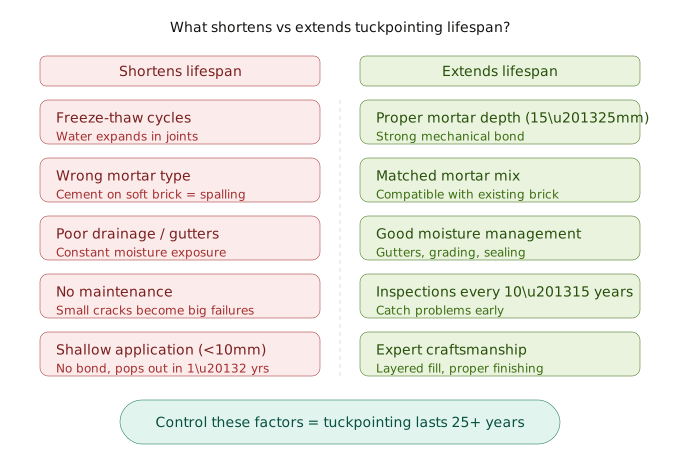
1. Mortar raking depth: The single biggest factor. Minimum 15–25 mm (2–2.5× joint width). Shallow raking = short lifespan, regardless of everything else.
2. Mortar type and compatibility: Mortar must be softer than or equal to the brick’s hardness. Portland cement on soft old brick traps moisture and causes spalling within 5–10 years.
3. Climate and exposure: Milwaukee’s harsh freeze-thaw cycles (70+ per year) stress mortar joints more than mild climates. South-facing and west-facing walls weather fastest.
4. Moisture management: Functioning gutters, proper grading, and adequate drainage keep water away from mortar joints. Poor drainage cuts tuckpointing lifespan by 30–50%.
5. Application technique: Mortar must be pressed in firmly in layers, not slapped in as a single pass. Layered application eliminates air pockets that weaken joints.
6. Maintenance and inspections: Regular inspections every 10–15 years catch small cracks before they become structural failures. Proactive maintenance extends how long tuckpointing lasts significantly.
According to the Brick Industry Association, mortar joint failure is the leading cause of brick wall deterioration — making tuckpointing quality critical to building longevity.
How Milwaukee’s Climate Impacts Tuckpointing Lifespan
Milwaukee’s climate is one of the harshest in the country for masonry. Understanding local conditions helps explain how long tuckpointing lasts in southeastern Wisconsin specifically:
| Climate Factor | Impact on Tuckpointing | How to Mitigate |
| Freeze-thaw cycles (70+/year) | Water expands 9% when frozen, cracking joints | Proper depth + lime mortar flexibility |
| Heavy rainfall | Drives moisture deep into joints | Good gutters + drainage |
| Road salt spray | Accelerates mortar erosion on ground floors | Annual wash + inspect lower courses |
| Summer humidity | Promotes efflorescence (white salt deposits) | Breathable lime mortar |
| Winter wind chill | Rapid temperature drops stress joint bonds | Correct curing (3–7 days protection) |
The National Weather Service in Milwaukee records data that directly influences how long tuckpointing lasts in our region. We factor local climate into every project plan.
Signs Your Tuckpointing Is Failing
Knowing the warning signs helps you act before minor cracks become major structural issues. Here’s how to tell if your tuckpointing is reaching the end of its life:
Crumbling or sandy mortar: Run your finger along a mortar joint. If it crumbles or feels gritty, the mortar has lost its binding strength.
Hairline cracks in joints: Small cracks allow water in. One freeze-thaw cycle turns a hairline crack into a gap.
Mortar pulling away from brick: If you can see a gap between the mortar and the brick edge, the bond has failed.
White staining (efflorescence): Salt deposits on the surface indicate moisture is moving through the mortar — a sign of permeability issues.
Loose or missing mortar chunks: Once mortar starts falling out, water infiltration accelerates rapidly.
Interior water stains: Dampness or staining on interior walls near exterior brickwork suggests failed mortar joints are allowing water through.
💡 When to Act
If you notice any of these signs, don’t wait. Early tuckpointing repair costs $300–$1,500. Waiting until damage spreads can turn the same problem into a $5,000–$15,000 project. This is the most impactful way to extend how long tuckpointing lasts.
How to Make Tuckpointing Last Longer
These proven maintenance practices directly extend how long tuckpointing lasts on your property:
1. Inspect every 10–15 years: Schedule a professional masonry inspection at least once every 10–15 years. In Milwaukee’s climate, we recommend every 10 years.
2. Maintain gutters and downspouts: Overflowing gutters dump water directly onto mortar joints. Clean gutters twice per year and ensure downspouts direct water away from walls.
3. Fix grading issues: The ground should slope away from the foundation at a minimum of 6 inches over 10 feet. Poor grading saturates lower mortar courses.
4. Address cracks immediately: Spot-repoint small failures as soon as they appear. A $200 repair today prevents a $2,000 repair in 3 years.
5. Avoid power washing mortar: High-pressure water blasts can erode mortar joints and force water into the wall. Use low-pressure washing (under 500 PSI) with appropriate detergent.
6. Consider breathable sealant: A vapour-permeable masonry sealant repels surface water while allowing internal moisture to escape. Reapply every 5–7 years.
Tuckpointing Maintenance Schedule
Follow this timeline to maximise how long tuckpointing lasts on your property:
| Timeline | Action | Estimated Cost |
| Annually | Clean gutters, visual check for cracks | Free / $0 |
| Every 3–5 years | Low-pressure wash, spot-check mortar | $100 – $300 |
| Every 5–7 years | Reapply breathable sealant | $200 – $600 |
| Every 10–15 years | Professional masonry inspection | $150 – $400 |
| Every 10–15 years | Spot-repoint any failed joints | $300 – $1,500 |
| Every 25–30 years | Full re-tuckpointing if needed | $1,500 – $10,000+ |
This schedule is based on Milwaukee’s climate. Properties in milder climates may extend intervals. Properties with heavy exposure (lakefront, high-traffic roads) should shorten them.
When to Re-Tuckpoint: Timeline Guide
Knowing when to re-tuckpoint depends on the original quality and current condition. Here’s a general guide:
If tuckpointing was done 5–10 years ago and is showing cracks, the original work was likely of poor quality. Re-tuckpoint with a professional contractor using the correct depth and mortar.
If tuckpointing was done 15–20 years ago and the mortar is softening, this is normal wear. Schedule a professional assessment to determine whether spot repair or full re-tuckpointing is needed.
If tuckpointing was done 25–30+ years ago and holding well: Excellent original work. Continue maintenance inspections every 10 years. You may not need re-tuckpointing for another decade.
If you don’t know when it was last done, get a professional assessment immediately. The mortar’s current condition matters more than its age.
Want Tuckpointing That Lasts 25+ Years?
Now you know how long tuckpointing lasts — and what makes the difference between 5 years and 50. North Shore Brickwork delivers expert tuckpointing with correct depth, matched mortar, and a maintenance plan for every project.
Contact North Shore Brickwork today for a free tuckpointing assessment.
FAQs | How Long Does Tuckpointing Last
Q: How long does tuckpointing last on average?
Professional tuckpointing lasts 20–30 years on average. Expert work with lime mortar can last 30–50+ years. Poor quality work fails in 2–5 years. The lifespan depends on mortar depth, material quality, climate, and maintenance.
Q: How long does tuckpointing last in cold climates like Milwaukee?
In Milwaukee’s freeze-thaw climate, professional tuckpointing typically lasts 20–25 years. The key is using mortar with slight flexibility (like lime-based mixes) that can absorb thermal expansion without cracking.
Q: Does mortar type affect how long tuckpointing lasts?
Yes, significantly. Portland cement mortar lasts 15–25 years, but can damage soft brick. Natural hydraulic lime (NHL) mortar lasts 30–50+ years and is self-healing for hairline cracks. Always match mortar type to your brick.
Q: How often should tuckpointing be inspected?
Every 10–15 years in moderate climates. Every 10 years in harsh climates like Milwaukee. Annual visual checks for obvious cracks or crumbling should be done by the homeowner.
Q: Can I extend how long tuckpointing lasts with maintenance?
Yes. Proper gutter maintenance, drainage, low-pressure washing, breathable sealant, and prompt spot repairs can add 5–15 years to tuckpointing lifespan.
Q: How do I know if my tuckpointing needs replacing?
Signs include crumbling or sandy mortar, hairline cracks, mortar pulling away from brick, white salt deposits (efflorescence), loose mortar chunks, and interior water stains.
Q: Is lime mortar tuckpointing worth the extra cost?
Yes for long-term value. Lime mortar costs 20–40% more upfront but lasts 30–50+ years vs 20–30 for standard. It’s also self-healing and protects soft or historic brick from spalling.
Q: How long does tuckpointing last on a chimney?
Chimney tuckpointing typically lasts 15–25 years because chimneys are more exposed to wind, rain, and temperature extremes than walls. Regular inspections are especially important for chimneys.
Q: Does tuckpointing increase property value?
Yes. Well-maintained tuckpointing improves curb appeal and prevents structural damage, both of which directly impact property value. A failed mortar is a red flag in home inspections.
Q: How long does tuckpointing last vs full brick replacement?
Tuckpointing lasts 20–50 years and costs $5–$25/sq ft. Full brick replacement lasts 75+ years but costs $20–$50+/sq ft. Tuckpointing is the cost-effective choice when bricks are sound.