Can I tuckpoint myself? It’s one of the most common questions Milwaukee homeowners ask when they see crumbling mortar on their brick walls. The DIY instinct is understandable — tuckpointing looks straightforward on YouTube, and the tools seem simple enough.
But here’s the truth from a team that repairs failed DIY tuckpointing jobs every week: what looks simple is deceptively complex. The margin for error is razor-thin, and the consequences of getting it wrong are expensive and sometimes irreversible.
In this guide, we give you an honest assessment of when you can tuckpoint yourself, when you absolutely should not, and how to evaluate your own situation. We’re not trying to scare you into hiring us — we’re trying to save you from the costly mistakes we see every day.
Can I Tuckpoint Myself? (The Honest Answer)
The honest answer to “Can I tuckpoint myself?” depends on three factors:
| Factor | DIY possible | Hire a professional |
| Area size | Under 5 sq ft | Over 5 sq ft |
| Location | Ground level only | Above 2 metres / any height |
| Brick type | Modern hard brick | Soft, historic, or cream city |
| Mortar condition | Surface cracks only | Deep erosion or failure |
| Number of joints | A few isolated joints | Wall sections or full walls |
| Experience level | Prior masonry work | No masonry experience |
If your project falls entirely in the “DIY possible” column, you can attempt a small tuckpointing repair with careful preparation. If any single factor falls in the “hire a professional” column, the risk of costly failure outweighs the savings.
What Tuckpointing Actually Involves
Before deciding whether you can tuckpoint yourself, understand what the process requires:
Step 1 — Mortar removal (raking): Deteriorated mortar must be removed to a minimum depth of 15–25 mm (2–2.5 times the joint width) without damaging the surrounding bricks. This step alone is where most DIY attempts fail.
Step 2 — Joint cleaning: All dust, debris, and loose material must be brushed out of the raked joints. Any contamination prevents the new mortar from bonding.
Step 3 — Dampening: Joints are misted with water before mortar application. Dry bricks absorb moisture from the fresh mortar, causing it to cure improperly and crumble within months.
Step 4 — Mortar mixing: The correct mortar type (Type N, Type O, or NHL lime) must be mixed to the right ratio with clean sand and the right amount of water. The consistency must be “butter-like” — too wet weakens it, too dry prevents bonding.
Step 5 — Mortar application: Fresh mortar is pressed into joints in 2–3 thin layers, each compressed with a pointing trowel at 45 degrees to eliminate air pockets. Single-layer filling creates weak bonds that fail quickly.
Step 6 — Joint profiling: The final joint must be shaped to match the existing profile (concave, flush, weather-struck, or recessed) for both water-shedding and visual consistency.
Step 7 — Curing protection: Fresh mortar must be protected from direct sun, rain, and freezing for 3–7 days. Improper curing is invisible at first but causes premature failure.
Each step has specific skill requirements and failure modes. Missing any one of them compromises the entire repair.
Tools You Need to Tuckpoint Yourself
If you’re still asking, “Can I tuckpoint myself?” here are the tools required for even a small repair:
| Tool | Purpose | Estimated cost |
| Mortar raker or plugging chisel | Hold the mortar while working | $15 – $40 |
| Club hammer | Drive the chisel for mortar removal | $10 – $25 |
| Stiff bristle brush | Clean joints after raking | $5 – $15 |
| Pointing trowel (narrow) | Press mortar into joints | $10 – $25 |
| Hawk (mortar board) | Joint finisher/jointer | $10 – $20 |
| Shape the final joint profile | Shape final joint profile | $10 – $20 |
| Spray bottle | Dampen joints before application | $3 – $5 |
| Mortar mix or components | Portland cement, lime, sand | $20 – $50 |
| Safety glasses and gloves | Eye and hand protection | $10 – $20 |
| Dust mask | Protection during raking | $5 – $15 |
Total tool investment: $100–$235 for a basic DIY setup. Professional tuckpointing for the same small area: $300–$600. The cost savings from DIY are minimal once you factor in tools, materials, and your time.
The Mason Contractors Association of America recommends that anyone asking, “Can I tuckpoint myself?” invest in proper tools rather than improvising, as the wrong tool is the leading cause of brick damage during DIY attempts.
5 Most Common DIY Tuckpointing Mistakes
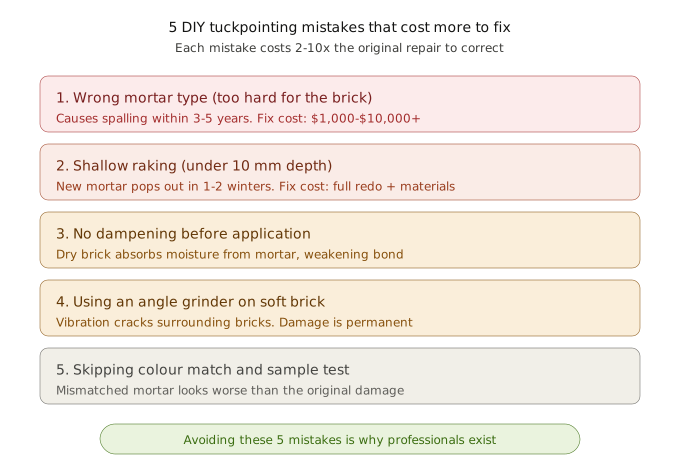
These are the five mistakes we repair most frequently when homeowners discover that “can I tuckpoint myself?” had a different answer than they expected:
Mistake 1: Using the wrong mortar type
This is the most damaging mistake. Using Portland cement mortar or Type S on soft, historic, or cream city brick causes the brick to spall within 3–5 years. The mortar is harder than the brick, traps moisture, and forces freeze-thaw pressure into the brick face instead of the joint.
Cost to fix: $1,000–$10,000+ (replacing spalled bricks plus correct repointing).
Mistake 2: Shallow raking (under 10 mm)
Many DIYers only scrape the surface mortar rather than raking to the required 15–25 mm depth. The new mortar has nothing to grip and pops out within 1–2 freeze-thaw cycles. The repair looks good initially but fails the first winter.
Cost to fix: Full redo at $8–$15/sq ft, plus wasted time and materials from the first attempt.
Mistake 3: Not dampening joints before application
Dry bricks absorb water from fresh mortar like a sponge. This robs the mortar of the moisture it needs to cure properly, resulting in powdery, weak joints that crumble when touched.
Mistake 4: Using an angle grinder on delicate brick
Angle grinders are fast but create intense vibration that cracks soft or old bricks adjacent to the joint being raked. The damage is permanent, and the cracked bricks must be replaced. Professional masons use oscillating multi-tools on delicate brick to avoid this.
Mistake 5: Skipping the colour match and sample test
Mismatched mortar is painfully obvious and can look worse than the original damage. Without sand colour matching and iron oxide pigment testing, DIY mortar rarely blends with existing joints.
💡 The most expensive DIY lesson
We recently corrected a DIY tuckpointing job on a Bay View cream city brick home. The homeowner used Type S mortar from a hardware store. Within two winters, 40+ bricks had spalled. The cost to replace the bricks and repoint correctly with NHL lime: $8,500. The original professional quote for correct tuckpointing: $3,200. The homeowner spent $200 on DIY materials plus $8,500 to fix the damage — $8,700 total instead of $3,200.
When DIY Tuckpointing Can Work
Despite the risks, there are specific scenarios where you can tuckpoint yourself successfully:
Small ground-level patches (under 5 sq ft): A few deteriorated joints on a garden wall or garage at ground level, using the correct mortar type, can be a successful DIY project.
Modern hard brick (post-1970): Standard red brick is more forgiving of mortar selection errors than soft or historic brick. Type N mortar from a masonry supply store works for most modern brick.
You have prior masonry experience: If you’ve worked with mortar before and understand joint profiling, you’re far more likely to achieve a lasting repair.
You’re willing to test first: Creating a sample patch, letting it cure 48 hours, and checking mortar hardness and colour compatibility before committing to the full repair dramatically reduces failure risk.
When You Should Never Tuckpoint Yourself
The answer to “can I tuckpoint myself?” is definitely no in these situations:
Any height above 2 metres: Working on scaffolding or ladders with masonry tools is a serious safety risk. Falls are the leading cause of injury in DIY masonry projects.
Soft, historic, or cream city brick: The margin for error with mortar hardness is razor-thin. One grade too hard causes irreversible brick damage.
Chimneys: Height, wind exposure, flashing complexity, and the structural importance of chimney integrity make chimney tuckpointing a professional-only job.
Large areas (full wall or more): Maintaining consistent mortar colour, depth, and joint profile across a large area requires professional skill and efficiency.
Structural cracks or bowing walls: These indicate structural issues that require engineering assessment, not DIY mortar repair.
Properties in historic districts: Non-compliant work may require removal and redo under preservation board supervision, at the homeowner’s expense.
The Real Cost: DIY vs Professional Tuckpointing
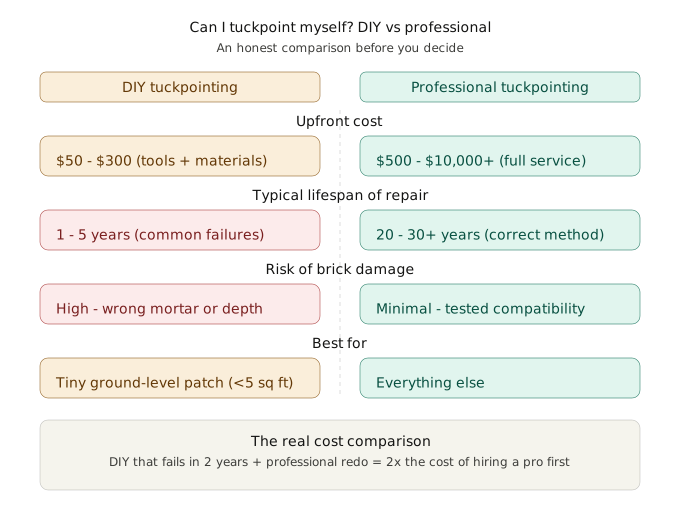
Here is the true cost comparison that answers “Can I tuckpoint myself and save money?”:
| Cost factor | DIY tuckpointing | Professional tuckpointing |
| Tools and materials | $100 – $235 | Included in quote |
| Your time (learning + work) | 8–16+ hours | 0 (they do it) |
| Repair quality | 1–5 year lifespan (typical) | 20–30+ year lifespan |
| Risk of brick damage | High (wrong mortar/tools) | Minimal |
| Cost if DIY fails | $1,000–$10,000+ to fix | N/A (warranty) |
| Total likely cost | $200 DIY + $3,000–$10,000 fix | $500–$3,000 (done right once) |
The bottom line: DIY tuckpointing saves $300–$500 upfront. If it fails — and most DIY tuckpointing does — the correction costs $1,000–$10,000+. Professional tuckpointing costs more initially but delivers 20–30+ years of protection with zero risk of self-inflicted damage.
The Brick Industry Association recommends professional tuckpointing for all structural mortar repair work, noting that incorrect DIY mortar is the leading cause of preventable brick damage in residential properties.
Why Milwaukee Makes DIY Tuckpointing Riskier
Milwaukee’s specific conditions make the question “Can I tuckpoint myself?” riskier than in milder climates:
70+ freeze-thaw cycles: DIY mortar mistakes that might survive 5 years in Georgia fail in 1–2 winters in Milwaukee. The testing cycle is unforgiving.
Cream city brick prevalence: Milwaukee’s iconic cream city brick is softer than standard red brick. Using the wrong mortar type causes spalling faster here than on harder brick elsewhere.
Road salt exposure: Salt accelerates mortar erosion on lower courses. Slightly weak DIY mortar degrades even faster under salt attack.
Seasonal curing challenges: Milwaukee’s narrow tuckpointing season (April–October) means DIY projects done in marginal weather risk incomplete curing before the first freeze.
How to Evaluate If You Can Tuckpoint Yourself
Before deciding whether you can tuckpoint yourself, answer these questions honestly:
| Question | DIY green light | Hire a pro |
| Have you worked with mortar before? | Yes | No |
| Do you know your brick type? | Modern hard brick | Not sure / soft / historic |
| Is the work ground level? | Yes | No |
| Is the area under 5 sq ft? | Yes | No |
| Can you get the correct mortar type? | Yes (masonry supply) | No (hardware store only) |
| Are you willing to test first? | Yes | No |
| Is there structural cracking? | No | Yes |
| Is the property in a historic district? | No | Yes |
If you answered “Diy green light” to every question, a small DIY tuckpointing repair is reasonable. If even one answer falls in the “Hire a pro” column, the risk outweighs the savings.
The ASTM C270 mortar standard provides the definitive specifications for mortar selection. Any homeowner asking “Can I tuckpoint myself?” should reference this standard before choosing a mortar type.
💡 Our honest advice
At North Shore Masonry, we don’t discourage DIY to protect our business — we discourage it to protect your brick. If you’re confident in your skills and the project fits the DIY criteria above, go for it. But if you have any doubt about your brick type or mortar selection, a $200 professional assessment before you start can save you $5,000–$10,000 in damage later.
Not Sure If You Can Tuckpoint Yourself?
A $200 professional assessment tells you exactly what your property needs, which mortar to use, and whether DIY is appropriate. If professional work is needed, North Shore Masonry provides transparent quotes with no obligation.
Contact North Shore Masonry today for a free tuckpointing assessment.
FAQs | Can I Tuckpoint Myself?
Q: Can I tuckpoint myself?
Technically, yes, but only for small ground-level repairs (under 5 sq ft) on modern hard brick with the correct mortar type. For soft brick, historic properties, chimneys, large areas, or any work above 2 metres, professional tuckpointing is essential to avoid costly damage.
Q: Is DIY tuckpointing cheaper than hiring a professional?
Upfront, yes: DIY costs $100–$235 for tools and materials vs. $500–$3,000 for professional work. However, most DIY tuckpointing fails within 1–5 years, and correction costs $1,000–$10,000+. Professional work lasts 20–30 years, making it cheaper long-term.
Q: What is the biggest risk of DIY tuckpointing?
Using the wrong mortar type. Portland cement or Type S on soft or historic brick causes spalling within 3–5 years. The brick damage is permanent and the correction costs 5–10x more than hiring a professional for the original job.
Q: What tools do I need to tuckpoint myself?
Mortar raker or plugging chisel, club hammer, stiff brush, pointing trowel, hawk, joint finisher, spray bottle, correct mortar mix, and safety gear. Total tool cost: $100–$235.
Q: How deep should I rake mortar for DIY tuckpointing?
Minimum 15–25 mm (2–2.5 times the joint width). Shallow raking under 10 mm is the second most common DIY mistake and causes new mortar to pop out within 1–2 winters.
Q: What mortar should I use for DIY tuckpointing?
Type N (1:1:6 cement:lime:sand) for modern hard brick. Never use Type S, pure Portland cement, or pre-mixed hardware store mortar without verifying the type. For soft or historic brick, always hire a professional — mortar selection is too critical.
Q: Can I tuckpoint my chimney myself?
No. Chimney tuckpointing involves height, scaffolding, wind exposure, flashing, and structural importance that make it unsafe and impractical for DIY. Always hire a professional for chimney work.
Q: How long does DIY tuckpointing last?
Typical DIY tuckpointing lasts 1–5 years due to common errors in depth, mortar type, and application technique. Professional tuckpointing lasts 20–30 years with standard mortar and 30–50+ years with lime mortar.
Q: Can I use mortar caulk instead of traditional tuckpointing?
Mortar caulk is acceptable only for hairline cosmetic cracks. It has no structural strength and peels off within 1–3 years. It is not a substitute for proper tuckpointing on deteriorated joints.
Q: Should I get a professional assessment before DIY tuckpointing?
Yes — a $200 professional assessment identifies your brick type, recommends the correct mortar, and confirms whether DIY is appropriate for your situation. This small investment prevents $5,000–$10,000 in potential DIY damage.