Materials for brick tuckpointing are the foundation of every successful mortar repair. The most skilled mason using the wrong mortar will produce work that fails within a few years, while the right materials applied correctly can last half a century.
Yet most homeowners focus on price when choosing a tuckpointing contractor, without realising that the materials specified in the quote are far more important than the labour rate. A contractor using cheap, incompatible mortar at $8 per square foot will cost you more in the long run than one using premium materials at $15.
In this guide, we cover every material decision involved in brick tuckpointing, from mortar type and sand grade to colour pigments and finishing tools. Every recommendation comes from our daily project experience at North Shore Masonry Milwaukee.
Why Materials for Brick Tuckpointing Matter More Than Technique
Here is a truth that surprises most homeowners: the materials for brick tuckpointing determine 70% of the repair’s lifespan. Technique accounts for the remaining 30%.
This is because mortar is a sacrificial element in masonry. It is designed to be softer than the bricks so that when moisture, freeze-thaw, and movement stress the wall, the mortar joints absorb the damage rather than the bricks.
If the mortar is harder than the brick — which happens when Portland cement-heavy mixes are used on soft or historic brick — the bricks fail instead of the mortar. The result is spalling, cracking, and irreversible brick damage that costs 5–10 times more to fix than the original tuckpointing.
The ASTM C270 mortar standard specifies exactly which mortar types are appropriate for different brick applications. Every contractor should reference this standard when selecting materials for brick tuckpointing.
Mortar Types: The Most Critical Materials for Brick Tuckpointing
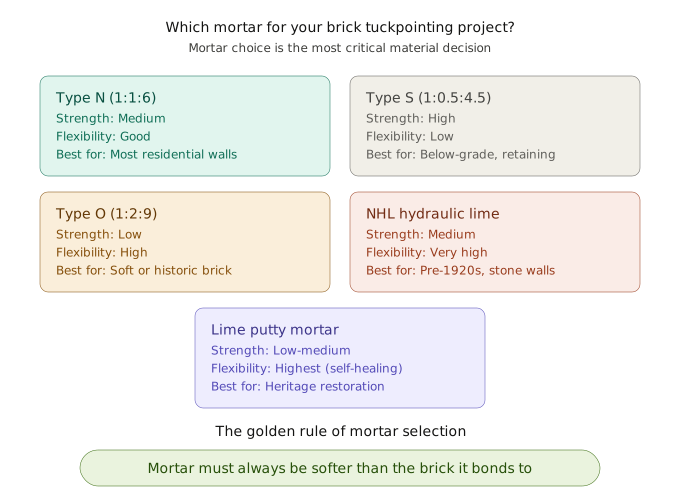
Mortar selection is the single most important material decision in any brick tuckpointing project. Here are the five primary mortar types and when to use each:
Type N mortar (1:1:6)
Type N is the standard choice for most residential tuckpointing. It offers a good balance of strength, flexibility, and workability. The 1:1:6 ratio (cement:lime:sand) produces mortar strong enough for above-grade walls but flexible enough to accommodate normal building movement.
This is the mortar we use for approximately 60% of our Milwaukee residential projects.
Type S mortar (1:0.5:4.5)
Type S provides higher compressive strength than Type N, making it suitable for below-grade applications, retaining walls, and areas subject to lateral soil pressure. However, its lower flexibility means it is not ideal for above-grade walls on older buildings.
Type O mortar (1:2:9)
Type O is the softest cement-based mortar and the best choice for soft or older brick that cannot withstand harder mortars. Its high lime content provides excellent flexibility and breathability. Use Type O on pre-1950 residential brick where Type N would be too rigid.
Natural hydraulic lime (NHL) mortar
NHL mortar is the gold standard of materials for brick tuckpointing on historic buildings. It sets through a chemical reaction with water (not air drying), is highly breathable, flexible, and self-healing for micro-cracks.
NHL mortar costs 20–40% more than cement-based options but delivers 30–50+ year lifespans. It is essential for pre-1920s buildings and all natural stone masonry.
Lime putty mortar
The most traditional of all materials for brick tuckpointing, lime putty mortar is made from slaked lime aged for months. It is the most flexible, most breathable, and slowest to cure. Use it for heritage restoration where absolute period accuracy is required.
| Mortar type | Ratio | Strength | Flexibility | Best for | Lifespan |
| Type N | 1:1:6 | Medium | Good | Most residential | 20–30 yrs |
| Type S | 1:0.5:4.5 | High | Low | Below-grade | 20–25 yrs |
| Type O | 1:2:9 | Low | High | Soft/old brick | 20–25 yrs |
| NHL lime | 0:1:3 | Medium | Very high | Historic, stone | 30–50+ yrs |
| Lime putty | 0:1:2.5 | Low-med | Highest | Heritage | 50+ yrs |
💡 The most expensive mistake in material selection
Using Type S or pure Portland cement mortar on soft historic brick is the single most damaging material error we see. The cement is harder than the brick, traps moisture, and causes irreversible spalling within 3–5 years. We’ve corrected hundreds of these failed jobs in Milwaukee. Always test mortar hardness against your brick before committing.
Mortar Mix Ratios: Getting the Proportions Right
Even with the right mortar type, incorrect mix ratios compromise the materials for brick tuckpointing. Here are the correct proportions:
| Mortar type | Cement | Lime | Sand | Water | Notes |
| Type N | 1 part | 1 part | 6 parts | As needed | Standard residential |
| Type S | 1 part | 0.5 parts | 4.5 parts | As needed | High-strength |
| Type O | 1 part | 2 parts | 9 parts | As needed | Soft brick |
| NHL 3.5 | 0 | 1 part | 2.5–3 parts | As needed | Historic brick |
| NHL 5 | 0 | 1 part | 2–2.5 parts | As needed | Wet exposure |
Water ratio is critical: Too much water weakens the mortar and causes shrinkage cracks. Too little makes it unworkable and prevents proper bonding. The correct consistency is “butter-like” — smooth enough to press into joints but firm enough to hold its shape on a trowel.
Sand Selection: An Overlooked Material for Brick Tuckpointing
Sand makes up 60–75% of mortar by volume, yet most homeowners never consider it. The type and quality of sand dramatically affects mortar performance:
Sharp sand (builder’s sand): Angular grains interlock mechanically, creating stronger mortar. This is the standard for most tuckpointing work.
Soft sand (plastering sand): Rounder grains produce smoother, more workable mortar but with slightly lower strength. Used for fine finishing and lime mortar applications.
Grain size distribution: Well-graded sand (mix of fine and coarse particles) produces the best mortar. Avoid uniformly fine sand, which creates weak, shrinkage-prone mortar.
Cleanliness: Sand must be free of clay, silt, and organic matter. Contaminated sand weakens mortar bonds and causes discolouration.
Colour impact: Sand colour is the primary determinant of mortar colour. Different sand sources produce dramatically different tones. Always test sand colour in a sample mix before purchasing in bulk.
The Brick Industry Association emphasises that sand quality is one of the most overlooked materials for brick tuckpointing, yet it directly determines mortar strength, colour, and longevity.
Colour Matching: Materials and Techniques for Seamless Repair
Colour matching is where the art of selecting materials for brick tuckpointing becomes most visible. Poorly matched mortar draws attention to the repair instead of hiding it.
How to achieve a perfect colour match
1. Source the right sand: Sand colour accounts for 70–80% of final mortar colour. Match the sand first, then fine-tune with pigments.
2. Use iron oxide pigments: These mineral-based colourants are UV-stable and permanent. Add 2–10% by weight of cement to adjust tone. Small changes create dramatic colour differences — test carefully.
3. Create sample panels: Mix 3–5 test batches with slightly different pigment ratios. Apply each to a small area and cure for 48 hours. Mortar colour changes significantly during curing.
4. Test in multiple lighting conditions: Check samples in direct sun, shade, and artificial light. Mortar can appear dramatically different depending on the lighting angle and intensity.
5. Account for weathering: New mortar will always look slightly different from 30-year-old mortar. Choose a colour that will age gracefully toward the existing tone rather than matching perfectly on day one.
Essential Tools: Materials for Brick Tuckpointing Application
The right tools are just as important as the right mortar when it comes to materials for brick tuckpointing:
| Tool | Purpose | Key specification |
| Mortar raker | Hold the mortar while working | Hand or electric, adjustable depth |
| Plugging chisel | Precision raking on delicate brick | Narrow blade, hardened steel |
| Pointing trowel | Press mortar into joints | Narrow width (10–12 mm) |
| Hawk | Similar to a pastry bag | Lightweight, flat surface |
| Mortar bag | Precise mortar application into joints | Shape the final joint profile |
| Joint finisher/jointer | Shape final joint profile | Match existing profile type |
| Stiff bristle brush | Clean joints before and after | Natural or nylon bristle |
| Spray bottle | Dampen joints pre-application | Fine mist setting |
💡 Tool tip from our team
For historic brick, we use a Fein MultiMaster oscillating tool with a carbide blade instead of an angle grinder. The oscillating action removes mortar precisely without the vibration that cracks soft old bricks. It’s slower but protects irreplaceable brickwork. This single tool choice separates professional materials for brick tuckpointing from amateur approaches.
Climate-Specific Material Considerations for Milwaukee
Milwaukee’s harsh climate demands specific attention when choosing materials for brick tuckpointing:
Freeze-thaw resistance: Milwaukee experiences 70+ freeze-thaw cycles per year. Mortar must be flexible enough to absorb thermal expansion without cracking. NHL lime mortar excels here due to its inherent flexibility.
Moisture management: Heavy rainfall and humidity require breathable mortar that allows moisture to escape through joints. Portland cement-heavy mortars trap moisture and accelerate freeze-thaw damage.
Road salt exposure: Properties near major roads experience salt splash that accelerates mortar erosion. Lower wall courses may need more frequent repointing regardless of mortar type.
Cream city brick compatibility: Milwaukee’s iconic cream city brick is softer than standard red brick. Always use Type O or NHL lime mortar on cream city brick — never Type S or pure cement.
The National Weather Service Milwaukee data directly influences how we select materials for brick tuckpointing on every project. Local climate knowledge is essential for material decisions.
Materials to Avoid in Brick Tuckpointing
Equally important as knowing the right materials for brick tuckpointing is knowing what to avoid:
| Material to avoid | Why it fails | What to use instead |
| Pure Portland cement mortar | Too hard, traps moisture, causes spalling | Type N, Type O, or NHL lime |
| Non-breathable sealants | Often the wrong type of brick | Vapour-permeable masonry sealant |
| Silicone caulk in joints | No structural bond, peels in 1–3 years | Proper lime or cement mortar |
| Play sand or beach sand | Contaminated, wrong grain size | Clean, sharp builder’s sand |
| Traps moisture behind the surface | Often wrong type for your brick | Custom-mixed mortar to specification |
| Dye-based colourants | Often, the wrong type of brick | Iron oxide mineral pigments |
The most important rule: if a material is not specifically designed for masonry, do not use it in tuckpointing. Shortcuts with inappropriate materials always cost more in the long run.
When to Consult a Professional About Materials for Brick Tuckpointing
While knowledgeable homeowners can make basic material decisions, professional guidance is essential in these situations:
Historic or pre-1920 buildings: Original mortar may contain unique ingredients (oyster shell lime, volcanic ash) that require laboratory analysis to replicate.
Cream city or soft brick: The margin for error with mortar hardness is very small. One grade too hard causes irreversible damage.
Previous failed repairs: If past tuckpointing has already failed, the replacement mortar type must be reassessed — repeating the same material guarantees repeat failure.
Large-scale projects: Full building facades require bulk material sourcing, consistent batching, and quality control that exceeds DIY capability.
Landmark or heritage properties: Preservation boards may specify exact material requirements. Non-compliance can result in fines or mandatory removal of non-conforming work.
Need Expert Material Selection for Your Tuckpointing Project?
North Shore Masonry specifies the correct materials for brick tuckpointing on every project. We custom-mix mortar on-site to match your brick type, colour, and climate conditions. No shortcuts, no generic mixes.
Contact North Shore Masonry today for a free tuckpointing assessment.
FAQs | Brick Tuckpointing
Q: What is the best mortar for brick tuckpointing?
Type N mortar (1:1:6 cement:lime:sand) is best for most residential projects. For soft or historic brick, use Type O or NHL lime mortar. For below-grade work, use Type S. The mortar must always be softer than the brick.
Q: Does sand type matter for tuckpointing?
Yes, significantly. Sand makes up 60–75% of mortar volume. Use clean, sharp builder’s sand with a well-graded particle distribution. Sand colour determines 70–80% of the final mortar colour. Never use play sand, beach sand, or contaminated material.
Q: How do you colour-match mortar for tuckpointing?
Start by matching the sand colour (the primary colour driver). Fine-tune with iron oxide pigments at 2–10% by cement weight. Create 3–5 sample panels, cure for 48 hours, and check in multiple lighting conditions before committing.
Q: Can I use Portland cement mortar for tuckpointing?
Only on modern, hard brick. Never use pure Portland cement on soft, historic, or cream city brick. Cement is harder than these bricks and traps moisture, causing spalling within 3–5 years. Use Type O or NHL lime mortar instead.
Q: What is NHL lime mortar and when should I use it?
Natural hydraulic lime (NHL) mortar sets chemically with water, is breathable, flexible, and self-healing. Use it on all pre-1920 buildings, natural stone, and any soft brick. It costs 20–40% more but lasts 30–50+ years.
Q: What tools do I need for brick tuckpointing?
Essential tools include a mortar raker, plugging chisel, pointing trowel, hawk, mortar bag, joint finisher, stiff brush, and spray bottle. For historic brick, an oscillating multi-tool replaces angle grinders to prevent vibration damage.
Q: Should I use premixed mortar from a hardware store?
For most tuckpointing projects, no. Premixed products are often Type S or general-purpose mixes that may be too hard for your specific brick. Custom-mixing mortar to the correct ratio ensures compatibility and longevity.
Q: What materials should I avoid in tuckpointing?
Avoid pure Portland cement mortar on soft brick, non-breathable sealants, silicone caulk in mortar joints, play sand, and dye-based colourants. All of these create problems worse than the original deteriorated mortar.
Q: How does Milwaukee’s climate affect material choice?
Milwaukee’s 70+ annual freeze-thaw cycles demand flexible, breathable mortar. NHL lime or Type N mortar performs best. Cream city brick requires extra care with softer mortars. Road salt exposure accelerates lower-course deterioration.
Q: How much do quality tuckpointing materials cost?
Standard mortar materials cost $2–5 per square foot of tuckpointing. NHL lime mortar adds 20–40% to material costs. Iron oxide pigments for colour matching add $1–3 per square foot. Quality materials are a small fraction of the total project cost but determine the repair’s lifespan.